专业英语
51CTO 软考题库 · 共 89 题(单选 86 + 问答 3)
1. At a basic level, cloud computing is simply a means of delivering IT resources as(请作答此空). Almost all IT resources can be delivered as a cloud service: applications, compute power, storage capacity, networking, programming tools, even communication services and collaboration( ). Cloud computing began as large-scale Internet service providers such as Google, Amazon, and others built out their infrastructure. An architecture emerged: massively scaled,( )distributed system resources, abstracted as virtual IT services and managed as continuously configured, pooled resources. In this architecture, the data is mostly resident on( )"somewhere on the Internet" and the application runs on both the "cloud servers" and the user's browser. Both clouds and grids are built to scale horizontally very efficiently. Both are built to with stand failures of( )elements or nodes. Both are charged on a per-use basis. But while grids typically process batch jobs, with a defined start and end point, cloud services can be continuous. What's more, clouds expand the types of resources available——file storage, databases, and Web services——and extend the applicability to Web and enterprise applications.
- A. hardware
- B. computers
- C. services
- D. software
答案:C
解析:
云计算主要是将资源看作云服务,包括应用程序、计算能力、存储容量、网络、编程工具,以及通信和协作工具。云计算最初由一些大的Internet服务提供商构建的基础设施而起步,其架构呈现出大规模、水平分布式系统资源、抽象的盯服务、管理持续配置、资源池等特性,数据大多存储于Internet上的某个地方的服务器上,应用程序运行于云服务器和用户浏览器中。 云和网格都针对有效的水平可扩展性,避免节点的单点失效对系统的影响,都按使用付费。它们的区别是网格通常是处理一批有明确定义起点和终点的作业,而云服务是可以连续不断的。另外,云扩展了资源的类型,包括文件存储、数据库和Web服务等,也将适用性扩展到Web和企业应用。
单选题
2. An architectural Style defines as a family of such systems in terms of a (1)、of structural organization. More specifically an architectural style defines a vocabulary of (2) and connector types, and a set of (3)on how they can be combined. For many styles there may also exist one or more(4) that specify how to determine a system's overall properties from the properties of its parts. Many of architectural styles have been developed over the years. The best-known examples of (5)architectures are programs written in the Unix shell.
- A. pattern(1)
- B. data flow(1)
- C. business process(1)
- D. position level(1)
答案:A
解析:
一种架构风格以一种结构化组织模式定义一组这样的系统。具体来说,一种架构风格定义了一个构件及连接器类型的词汇表,以及一组关于它们如何能够被关联的约束。对于许多风格来说,可能也存在一个或多个语义模型,从系统部件的特性来确定系统的整体特性。许多架构风格已经发展了很多年,众所周知的管道-过滤器架构的例子就是用UNIX shell编写的程序。
单选题
3. An architectural Style defines as a family of such systems in terms of a (1)、of structural organization. More specifically an architectural style defines a vocabulary of (2) and connector types, and a set of (3)on how they can be combined. For many styles there may also exist one or more(4) that specify how to determine a system's overall properties from the properties of its parts. Many of architectural styles have been developed over the years. The best-known examples of (5)architectures are programs written in the Unix shell.
- A. metadata(2)
- B. components(2)
- C. models(2)
- D. entities(2)
答案:B
解析:
一种架构风格以一种结构化组织模式定义一组这样的系统。具体来说,一种架构风格定义了一个构件及连接器类型的词汇表,以及一组关于它们如何能够被关联的约束。对于许多风格来说,可能也存在一个或多个语义模型,从系统部件的特性来确定系统的整体特性。许多架构风格已经发展了很多年,众所周知的管道-过滤器架构的例子就是用UNIX shell编写的程序。
单选题
4. An architectural Style defines as a family of such systems in terms of a (1)、of structural organization. More specifically an architectural style defines a vocabulary of (2) and connector types, and a set of (3)on how they can be combined. For many styles there may also exist one or more(4) that specify how to determine a system's overall properties from the properties of its parts. Many of architectural styles have been developed over the years. The best-known examples of (5)architectures are programs written in the Unix shell.
- A. functions(3)
- B. code segments(3)
- C. interfaces(3)
- D. constraints(3)
答案:D
解析:
一种架构风格以一种结构化组织模式定义一组这样的系统。具体来说,一种架构风格定义了一个构件及连接器类型的词汇表,以及一组关于它们如何能够被关联的约束。对于许多风格来说,可能也存在一个或多个语义模型,从系统部件的特性来确定系统的整体特性。许多架构风格已经发展了很多年,众所周知的管道-过滤器架构的例子就是用UNIX shell编写的程序。
单选题
5. An architectural Style defines as a family of such systems in terms of a (1)、of structural organization. More specifically an architectural style defines a vocabulary of (2) and connector types, and a set of (3)on how they can be combined. For many styles there may also exist one or more(4) that specify how to determine a system's overall properties from the properties of its parts. Many of architectural styles have been developed over the years. The best-known examples of (5)architectures are programs written in the Unix shell.
- A. semantic models(4)
- B. weak entities(4)
- C. data schemas(4)
- D. business models(4)
答案:A
解析:
一种架构风格以一种结构化组织模式定义一组这样的系统。具体来说,一种架构风格定义了一个构件及连接器类型的词汇表,以及一组关于它们如何能够被关联的约束。对于许多风格来说,可能也存在一个或多个语义模型,从系统部件的特性来确定系统的整体特性。许多架构风格已经发展了很多年,众所周知的管道-过滤器架构的例子就是用UNIX shell编写的程序。
单选题
6. An architectural Style defines as a family of such systems in terms of a (1)、of structural organization. More specifically an architectural style defines a vocabulary of (2) and connector types, and a set of (3)on how they can be combined. For many styles there may also exist one or more(4) that specify how to determine a system's overall properties from the properties of its parts. Many of architectural styles have been developed over the years. The best-known examples of (5)architectures are programs written in the Unix shell.
- A. event-based(5)
- B. object-oriented(5)
- C. pipe-and-filter(5)
- D. layered(5)
答案:C
解析:
一种架构风格以一种结构化组织模式定义一组这样的系统。具体来说,一种架构风格定义了一个构件及连接器类型的词汇表,以及一组关于它们如何能够被关联的约束。对于许多风格来说,可能也存在一个或多个语义模型,从系统部件的特性来确定系统的整体特性。许多架构风格已经发展了很多年,众所周知的管道-过滤器架构的例子就是用UNIX shell编写的程序。
单选题
7. Traditional structured analysis techniques focus upon the flow of (1) within a system. Object-oriented analysis emphasizes the building of real-world models, It examines requirements from the perspective of the classes and objects found in the vocabulary of the (2) domain. Traditional system design method emphasizes the proper and effective structure of a complex system. Object-oriented design method encompasses the process of object- oriented decomposition and a (3) for depicting both logical and physical as well as static and dynamic models of the system under design. Object-oriented programming is a method of implementation in which programs are organized as cooperative collections of objects, each of which represents an (4) of some class, and whose classes are all members of a hierarchy of classes united via (5) relationships.
- A. control
- B. program
- C. data
- D. reference
答案:C
解析(AI 生成):
结构化分析以数据流为中心,用数据流图刻画系统内数据的流动、加工与存储,故填data。control指控制流,program与reference都不是结构化分析的建模对象;只有面向对象方法才转向以问题域中的类与对象建模。
单选题
8. Traditional structured analysis techniques focus upon the flow of (1) within a system. Object-oriented analysis emphasizes the building of real-world models, It examines requirements from the perspective of the classes and objects found in the vocabulary of the (2) domain. Traditional system design method emphasizes the proper and effective structure of a complex system. Object-oriented design method encompasses the process of object- oriented decomposition and a (3) for depicting both logical and physical as well as static and dynamic models of the system under design. Object-oriented programming is a method of implementation in which programs are organized as cooperative collections of objects, each of which represents an (4) of some class, and whose classes are all members of a hierarchy of classes united via (5) relationships.
- A. problem
- B. solution
- C. data
- D. program
答案:A
解析(AI 生成):
面向对象分析从问题域(problem domain)的词汇中寻找类与对象,直接建立现实世界模型。solution指解域即实现域,属于设计阶段关注的内容;data与program是结构化视角的表述,也不能与domain搭配表示需求的来源。
单选题
9. Traditional structured analysis techniques focus upon the flow of (1) within a system. Object-oriented analysis emphasizes the building of real-world models, It examines requirements from the perspective of the classes and objects found in the vocabulary of the (2) domain. Traditional system design method emphasizes the proper and effective structure of a complex system. Object-oriented design method encompasses the process of object- oriented decomposition and a (3) for depicting both logical and physical as well as static and dynamic models of the system under design. Object-oriented programming is a method of implementation in which programs are organized as cooperative collections of objects, each of which represents an (4) of some class, and whose classes are all members of a hierarchy of classes united via (5) relationships.
- A. mark
- B. picture
- C. symbol
- D. notation
答案:D
解析(AI 生成):
此处指一种描述逻辑与物理、静态与动态模型的表示法,notation意为成体系的符号表示(如UML),与design method搭配。mark指记号、picture指图形、symbol多指单个符号,都不能表达完整的建模表示法。
单选题
10. Traditional structured analysis techniques focus upon the flow of (1) within a system. Object-oriented analysis emphasizes the building of real-world models, It examines requirements from the perspective of the classes and objects found in the vocabulary of the (2) domain. Traditional system design method emphasizes the proper and effective structure of a complex system. Object-oriented design method encompasses the process of object- oriented decomposition and a (3) for depicting both logical and physical as well as static and dynamic models of the system under design. Object-oriented programming is a method of implementation in which programs are organized as cooperative collections of objects, each of which represents an (4) of some class, and whose classes are all members of a hierarchy of classes united via (5) relationships.
- A. instance
- B. example
- C. existence
- D. implementation
答案:A
解析(AI 生成):
面向对象程序中对象是类的实例,即每个对象是某个类的一个instance。example意为例子,existence意为存在,implementation意为实现,都不能表达由类创建出来的具体对象这一含义。
单选题
11. Traditional structured analysis techniques focus upon the flow of (1) within a system. Object-oriented analysis emphasizes the building of real-world models, It examines requirements from the perspective of the classes and objects found in the vocabulary of the (2) domain. Traditional system design method emphasizes the proper and effective structure of a complex system. Object-oriented design method encompasses the process of object- oriented decomposition and a (3) for depicting both logical and physical as well as static and dynamic models of the system under design. Object-oriented programming is a method of implementation in which programs are organized as cooperative collections of objects, each of which represents an (4) of some class, and whose classes are all members of a hierarchy of classes united via (5) relationships.
- A. control
- B. inheritance
- C. inference
- D. connection
答案:B
解析(AI 生成):
类之间通过继承(inheritance)形成层次结构,子类复用并扩展父类,这是面向对象实现复用的核心机制。control、inference、connection分别指控制、推理与连接,与类层次及复用关系无关。
单选题
12. An architectural Style defines as a family of such systems in terms of a (1)、of structural organization. More specifically an architectural style defines a vocabulary of (2)and connector types, and a set of (3)on how they can be combined. For many styles there may also exist one or more(4)that specify how to determine a system's overall properties from the properties of its parts. Many of architectural styles have been developed over the years. The best-known examples of (5)architectures are programs written in the Unix shell.
- A. metadata
- B. components
- C. models
- D. entities
答案:B
解析(AI 生成):
体系结构风格用构件(components)与连接件类型定义结构组织。metadata指元数据,models与entities指模型和实体,都不是与connector并列的基本结构要素,无法构成风格的基本词汇表。
单选题
13. An architectural Style defines as a family of such systems in terms of a (1)、of structural organization. More specifically an architectural style defines a vocabulary of (2)and connector types, and a set of (3)on how they can be combined. For many styles there may also exist one or more(4)that specify how to determine a system's overall properties from the properties of its parts. Many of architectural styles have been developed over the years. The best-known examples of (5)architectures are programs written in the Unix shell.
- A. semantic models
- B. weak entities
- C. data schemas
- D. business models
答案:A
解析(AI 生成):
风格还可配有语义模型(semantic models),由各部分性质推导系统整体性质,如管道-过滤器的整体吞吐与延迟。weak entities属数据库概念,data schemas与business models也不承担这种推导作用。
单选题
14. An architectural Style defines as a family of such systems in terms of a (1)、of structural organization. More specifically an architectural style defines a vocabulary of (2)and connector types, and a set of (3)on how they can be combined. For many styles there may also exist one or more(4)that specify how to determine a system's overall properties from the properties of its parts. Many of architectural styles have been developed over the years. The best-known examples of (5)architectures are programs written in the Unix shell.
- A. event-based
- B. object-oriented
- C. pipe-and-filter
- D. layered
答案:C
解析(AI 生成):
Unix shell用管道把命令首尾相连,前一命令输出作为后一命令输入,是管道-过滤器(pipe-and-filter)风格的典型实例。event-based靠事件触发,object-oriented以对象协作,layered按层调用。
单选题
15. (71)data effectively is crucial for success in today's competitive environment. Managers must know how to use a variety of tools. Integrated data takes information from different sources and puts it together in a meaningful and useful way. One of the difficulties of this is the (72) in hardware and software.(73)integration uses a base document that contains copies of other objects. (74) integration uses a base document that contains the current or most recent version of the source document it contains. (75) provides an overview of the program written in "plain" English, without the computer syntax.
- A. Generalizing(71)
- B. Sharing(71)
- C. General-using(71)
- D. Globalizing(71)
答案:B
解析:
在当今的竞争环境下,要想取得成功,有效地共享数据是十分重要的。管理人员必须知道如何使用一系列不同的工具。数据集成使来自不同数据源的数据以一种有效和有用的方式组合在一起。这种集成面临的一个困难就是软硬件的多样性问题。静态集成使用一个包含其他主题的基础文档,动态集成使用它所包含的源文档的当前或最近的版本。 伪代码通过使用简单易懂的,不带有计算机语法的英语,为程序提供了一个概貌。
单选题
16. (71)data effectively is crucial for success in today's competitive environment. Managers must know how to use a variety of tools. Integrated data takes information from different sources and puts it together in a meaningful and useful way. One of the difficulties of this is the (72) in hardware and software.(73)integration uses a base document that contains copies of other objects. (74) integration uses a base document that contains the current or most recent version of the source document it contains. (75) provides an overview of the program written in "plain" English, without the computer syntax.
- A. similarity(72)
- B. interoperability(72)
- C. diversity(72)
- D. interaction(72)
答案:C
解析:
在当今的竞争环境下,要想取得成功,有效地共享数据是十分重要的。管理人员必须知道如何使用一系列不同的工具。数据集成使来自不同数据源的数据以一种有效和有用的方式组合在一起。这种集成面临的一个困难就是软硬件的多样性问题。静态集成使用一个包含其他主题的基础文档,动态集成使用它所包含的源文档的当前或最近的版本。 伪代码通过使用简单易懂的,不带有计算机语法的英语,为程序提供了一个概貌。
单选题
17. (71)data effectively is crucial for success in today's competitive environment. Managers must know how to use a variety of tools. Integrated data takes information from different sources and puts it together in a meaningful and useful way. One of the difficulties of this is the (72) in hardware and software.(73)integration uses a base document that contains copies of other objects. (74) integration uses a base document that contains the current or most recent version of the source document it contains. (75) provides an overview of the program written in "plain" English, without the computer syntax.
- A. Simulated(73)
- B. Duplicated(73)
- C. Dynamic(73)
- D. Static(73)
答案:D
解析:
在当今的竞争环境下,要想取得成功,有效地共享数据是十分重要的。管理人员必须知道如何使用一系列不同的工具。数据集成使来自不同数据源的数据以一种有效和有用的方式组合在一起。这种集成面临的一个困难就是软硬件的多样性问题。静态集成使用一个包含其他主题的基础文档,动态集成使用它所包含的源文档的当前或最近的版本。 伪代码通过使用简单易懂的,不带有计算机语法的英语,为程序提供了一个概貌。
单选题
18. (71)data effectively is crucial for success in today's competitive environment. Managers must know how to use a variety of tools. Integrated data takes information from different sources and puts it together in a meaningful and useful way. One of the difficulties of this is the (72) in hardware and software.(73)integration uses a base document that contains copies of other objects. (74) integration uses a base document that contains the current or most recent version of the source document it contains. (75) provides an overview of the program written in "plain" English, without the computer syntax.
- A. Linked(74)
- B. Pointed(74)
- C. Dynamic(74)
- D. Static(74)
答案:C
解析:
在当今的竞争环境下,要想取得成功,有效地共享数据是十分重要的。管理人员必须知道如何使用一系列不同的工具。数据集成使来自不同数据源的数据以一种有效和有用的方式组合在一起。这种集成面临的一个困难就是软硬件的多样性问题。静态集成使用一个包含其他主题的基础文档,动态集成使用它所包含的源文档的当前或最近的版本。 伪代码通过使用简单易懂的,不带有计算机语法的英语,为程序提供了一个概貌。
单选题
19. (71)data effectively is crucial for success in today's competitive environment. Managers must know how to use a variety of tools. Integrated data takes information from different sources and puts it together in a meaningful and useful way. One of the difficulties of this is the (72) in hardware and software.(73)integration uses a base document that contains copies of other objects. (74) integration uses a base document that contains the current or most recent version of the source document it contains. (75) provides an overview of the program written in "plain" English, without the computer syntax.
- A. High-level language(75)
- B. Decision tree(75)
- C. Pseudo code(75)
- D. Flowchart(75)
答案:C
解析:
在当今的竞争环境下,要想取得成功,有效地共享数据是十分重要的。管理人员必须知道如何使用一系列不同的工具。数据集成使来自不同数据源的数据以一种有效和有用的方式组合在一起。这种集成面临的一个困难就是软硬件的多样性问题。静态集成使用一个包含其他主题的基础文档,动态集成使用它所包含的源文档的当前或最近的版本。 伪代码通过使用简单易懂的,不带有计算机语法的英语,为程序提供了一个概貌。
单选题
20. An architectural Style defines as a family of such systems in terms of a (1)、of structural organization. More specifically an architectural style defines a vocabulary of (2) and connector types, and a set of (3)on how they can be combined. For many styles there may also exist one or more(4) that specify how to determine a system's overall properties from the properties of its parts. Many of architectural styles have been developed over the years. The best-known examples of (5)architectures are programs written in the Unix shell.
- A. pattern
- B. data flow
- C. business process
- D. position level
答案:A
解析:
一种架构风格以一种结构化组织模式定义一组这样的系统。具体来说,一种架构风格定义了一个构件及连接器类型的词汇表,以及一组关于它们如何能够被关联的约束对于许多风格来说,可能也存在一个或多个语义模型,从系统部件的特性来确定系统的整体特性。许多架构风格已经发展了很多年,管道和过滤器体系结构最著名的例子是在Unix shell中编写的程序。
单选题
21. An architectural Style defines as a family of such systems in terms of a (1)、of structural organization. More specifically an architectural style defines a vocabulary of (2) and connector types, and a set of (3)on how they can be combined. For many styles there may also exist one or more(4) that specify how to determine a system's overall properties from the properties of its parts. Many of architectural styles have been developed over the years. The best-known examples of (5)architectures are programs written in the Unix shell.
- A. metadata
- B. components
- C. models
- D. entities
答案:B
解析:
一种架构风格以一种结构化组织模式定义一组这样的系统。具体来说,一种架构风格定义了一个构件及连接器类型的词汇表,以及一组关于它们如何能够被关联的约束对于许多风格来说,可能也存在一个或多个语义模型,从系统部件的特性来确定系统的整体特性。许多架构风格已经发展了很多年,管道和过滤器体系结构最著名的例子是在Unix shell中编写的程序。
单选题
22. An architectural Style defines as a family of such systems in terms of a (1)、of structural organization. More specifically an architectural style defines a vocabulary of (2) and connector types, and a set of (3)on how they can be combined. For many styles there may also exist one or more(4) that specify how to determine a system's overall properties from the properties of its parts. Many of architectural styles have been developed over the years. The best-known examples of (5)architectures are programs written in the Unix shell.
- A. functions
- B. code segments
- C. interfaces
- D. constraints
答案:D
解析:
一种架构风格以一种结构化组织模式定义一组这样的系统。具体来说,一种架构风格定义了一个构件及连接器类型的词汇表,以及一组关于它们如何能够被关联的约束对于许多风格来说,可能也存在一个或多个语义模型,从系统部件的特性来确定系统的整体特性。许多架构风格已经发展了很多年,管道和过滤器体系结构最著名的例子是在Unix shell中编写的程序。
单选题
23. An architectural Style defines as a family of such systems in terms of a (1)、of structural organization. More specifically an architectural style defines a vocabulary of (2) and connector types, and a set of (3)on how they can be combined. For many styles there may also exist one or more(4) that specify how to determine a system's overall properties from the properties of its parts. Many of architectural styles have been developed over the years. The best-known examples of (5)architectures are programs written in the Unix shell.
- A. semantic models
- B. weak entities
- C. data schemas
- D. business models
答案:A
解析:
一种架构风格以一种结构化组织模式定义一组这样的系统。具体来说,一种架构风格定义了一个构件及连接器类型的词汇表,以及一组关于它们如何能够被关联的约束对于许多风格来说,可能也存在一个或多个语义模型,从系统部件的特性来确定系统的整体特性。许多架构风格已经发展了很多年,管道和过滤器体系结构最著名的例子是在Unix shell中编写的程序。
单选题
24. An architectural Style defines as a family of such systems in terms of a (1)、of structural organization. More specifically an architectural style defines a vocabulary of (2) and connector types, and a set of (3)on how they can be combined. For many styles there may also exist one or more(4) that specify how to determine a system's overall properties from the properties of its parts. Many of architectural styles have been developed over the years. The best-known examples of (5)architectures are programs written in the Unix shell.
- A. event-based
- B. object-oriented
- C. pipe-and-filter
- D. layered
答案:C
解析:
一种架构风格以一种结构化组织模式定义一组这样的系统。具体来说,一种架构风格定义了一个构件及连接器类型的词汇表,以及一组关于它们如何能够被关联的约束对于许多风格来说,可能也存在一个或多个语义模型,从系统部件的特性来确定系统的整体特性。许多架构风格已经发展了很多年,管道和过滤器体系结构最著名的例子是在Unix shell中编写的程序。
单选题
25. In the fields of physical security and information security, access (1)is the selective restriction of access to a place or other resource. The act of accessing may mean consuming, entering, or using. Permission to access a resource is called(2). An access control mechanism connects between a user (or a process executing on behalf of a user) and system resources, such as applications, operating systems, firewalls, routers, files, and databases. The system must first authenticate a user seeking access. Typically the authentication function determines whether the user is permitted to access the system at all. Then the access control function determines if the specific requested access by this user is permitted. A security administrator (3)an authorization database that specifies what type of access to which resources is allowed for this user. The access control function consults this database to determine whether to grant access. An auditing function (4)and keeps a record of user accesses to system resources. In practice, a number of users may cooperatively share the access control function. All operating systems have at least a(5), and in many cases a quite robust, access control component. Add-on security packages can add to the automated access control capabilities of the OS. Particular applications or utilities, such as a database management system, also incorporate access control functions. External devices, such as firewalls, can also provide access control services.
- A. cooperates
- B. coordinates
- C. control
- D. mediates
答案:C
解析:
在物理安全和信息安全领域,访问(71)是对一个地方或其他资源的访问限制。访问的行为可能意味着消费、输入或使用。允许访问资源被称为(72)。访问控制机制连接用户(代表用户执行的进程)和系统资源(如应用程序、操作系统、防火墙、路由器、文件和数据库)之间的连接。系统必须首先对用户进行身份验证。通常,身份验证功能决定用户是否允许访问系统。然后,访问控制功能决定是否允许该用户指定的访问权限。安全管理员(73)一个授权数据库,该数据库指定允许该用户访问哪些资源的类型。访问控制函数咨询此数据库以确定是否授予访问权。审计功能(74)并保存用户访问系统资源的记录。 在实践中,一些用户可以合作共享访问控制函数。所有操作系统都至少有一个(75),而且在许多情况下是一个相当健壮的访问控制组件。附加安全包可以添加到操作系统的自动的访问控制功能。特定的应用程序或实用程序,如数据库管理系统,也包括访问控制功能。外部设备,如防火墙,也可以提供访问控制服务。 (71)A.合作 B.协调 C.控制 D.调解 (72)A.功能 B.授权 C.安全 D.能力 (73)A.开放 B.监视 C.维护 D.寻找 (74)A.组件 B.监视 C.机制 D.算法 (75)A.遥远的 B.原始的 C.被控制的 D.基本的
单选题
26. In the fields of physical security and information security, access (1)is the selective restriction of access to a place or other resource. The act of accessing may mean consuming, entering, or using. Permission to access a resource is called(2). An access control mechanism connects between a user (or a process executing on behalf of a user) and system resources, such as applications, operating systems, firewalls, routers, files, and databases. The system must first authenticate a user seeking access. Typically the authentication function determines whether the user is permitted to access the system at all. Then the access control function determines if the specific requested access by this user is permitted. A security administrator (3)an authorization database that specifies what type of access to which resources is allowed for this user. The access control function consults this database to determine whether to grant access. An auditing function (4)and keeps a record of user accesses to system resources. In practice, a number of users may cooperatively share the access control function. All operating systems have at least a(5), and in many cases a quite robust, access control component. Add-on security packages can add to the automated access control capabilities of the OS. Particular applications or utilities, such as a database management system, also incorporate access control functions. External devices, such as firewalls, can also provide access control services.
- A. function
- B. authorization
- C. security
- D. capabilities
答案:B
解析:
在物理安全和信息安全领域,访问(71)是对一个地方或其他资源的访问限制。访问的行为可能意味着消费、输入或使用。允许访问资源被称为(72)。访问控制机制连接用户(代表用户执行的进程)和系统资源(如应用程序、操作系统、防火墙、路由器、文件和数据库)之间的连接。系统必须首先对用户进行身份验证。通常,身份验证功能决定用户是否允许访问系统。然后,访问控制功能决定是否允许该用户指定的访问权限。安全管理员(73)一个授权数据库,该数据库指定允许该用户访问哪些资源的类型。访问控制函数咨询此数据库以确定是否授予访问权。审计功能(74)并保存用户访问系统资源的记录。 在实践中,一些用户可以合作共享访问控制函数。所有操作系统都至少有一个(75),而且在许多情况下是一个相当健壮的访问控制组件。附加安全包可以添加到操作系统的自动的访问控制功能。特定的应用程序或实用程序,如数据库管理系统,也包括访问控制功能。外部设备,如防火墙,也可以提供访问控制服务。 (71)A.合作 B.协调 C.控制 D.调解 (72)A.功能 B.授权 C.安全 D.能力 (73)A.开放 B.监视 C.维护 D.寻找 (74)A.组件 B.监视 C.机制 D.算法 (75)A.遥远的 B.原始的 C.被控制的 D.基本的
单选题
27. In the fields of physical security and information security, access (1)is the selective restriction of access to a place or other resource. The act of accessing may mean consuming, entering, or using. Permission to access a resource is called(2). An access control mechanism connects between a user (or a process executing on behalf of a user) and system resources, such as applications, operating systems, firewalls, routers, files, and databases. The system must first authenticate a user seeking access. Typically the authentication function determines whether the user is permitted to access the system at all. Then the access control function determines if the specific requested access by this user is permitted. A security administrator (3)an authorization database that specifies what type of access to which resources is allowed for this user. The access control function consults this database to determine whether to grant access. An auditing function (4)and keeps a record of user accesses to system resources. In practice, a number of users may cooperatively share the access control function. All operating systems have at least a(5), and in many cases a quite robust, access control component. Add-on security packages can add to the automated access control capabilities of the OS. Particular applications or utilities, such as a database management system, also incorporate access control functions. External devices, such as firewalls, can also provide access control services.
- A. opens
- B. monitors
- C. maintains
- D. seeks
答案:C
解析:
在物理安全和信息安全领域,访问(71)是对一个地方或其他资源的访问限制。访问的行为可能意味着消费、输入或使用。允许访问资源被称为(72)。访问控制机制连接用户(代表用户执行的进程)和系统资源(如应用程序、操作系统、防火墙、路由器、文件和数据库)之间的连接。系统必须首先对用户进行身份验证。通常,身份验证功能决定用户是否允许访问系统。然后,访问控制功能决定是否允许该用户指定的访问权限。安全管理员(73)一个授权数据库,该数据库指定允许该用户访问哪些资源的类型。访问控制函数咨询此数据库以确定是否授予访问权。审计功能(74)并保存用户访问系统资源的记录。 在实践中,一些用户可以合作共享访问控制函数。所有操作系统都至少有一个(75),而且在许多情况下是一个相当健壮的访问控制组件。附加安全包可以添加到操作系统的自动的访问控制功能。特定的应用程序或实用程序,如数据库管理系统,也包括访问控制功能。外部设备,如防火墙,也可以提供访问控制服务。 (71)A.合作 B.协调 C.控制 D.调解 (72)A.功能 B.授权 C.安全 D.能力 (73)A.开放 B.监视 C.维护 D.寻找 (74)A.组件 B.监视 C.机制 D.算法 (75)A.遥远的 B.原始的 C.被控制的 D.基本的
单选题
28. In the fields of physical security and information security, access (1)is the selective restriction of access to a place or other resource. The act of accessing may mean consuming, entering, or using. Permission to access a resource is called(2). An access control mechanism connects between a user (or a process executing on behalf of a user) and system resources, such as applications, operating systems, firewalls, routers, files, and databases. The system must first authenticate a user seeking access. Typically the authentication function determines whether the user is permitted to access the system at all. Then the access control function determines if the specific requested access by this user is permitted. A security administrator (3)an authorization database that specifies what type of access to which resources is allowed for this user. The access control function consults this database to determine whether to grant access. An auditing function (4)and keeps a record of user accesses to system resources. In practice, a number of users may cooperatively share the access control function. All operating systems have at least a(5), and in many cases a quite robust, access control component. Add-on security packages can add to the automated access control capabilities of the OS. Particular applications or utilities, such as a database management system, also incorporate access control functions. External devices, such as firewalls, can also provide access control services.
- A. components
- B. monitors
- C. mechanisms
- D. algorithms
答案:B
解析:
在物理安全和信息安全领域,访问(71)是对一个地方或其他资源的访问限制。访问的行为可能意味着消费、输入或使用。允许访问资源被称为(72)。访问控制机制连接用户(代表用户执行的进程)和系统资源(如应用程序、操作系统、防火墙、路由器、文件和数据库)之间的连接。系统必须首先对用户进行身份验证。通常,身份验证功能决定用户是否允许访问系统。然后,访问控制功能决定是否允许该用户指定的访问权限。安全管理员(73)一个授权数据库,该数据库指定允许该用户访问哪些资源的类型。访问控制函数咨询此数据库以确定是否授予访问权。审计功能(74)并保存用户访问系统资源的记录。 在实践中,一些用户可以合作共享访问控制函数。所有操作系统都至少有一个(75),而且在许多情况下是一个相当健壮的访问控制组件。附加安全包可以添加到操作系统的自动的访问控制功能。特定的应用程序或实用程序,如数据库管理系统,也包括访问控制功能。外部设备,如防火墙,也可以提供访问控制服务。 (71)A.合作 B.协调 C.控制 D.调解 (72)A.功能 B.授权 C.安全 D.能力 (73)A.开放 B.监视 C.维护 D.寻找 (74)A.组件 B.监视 C.机制 D.算法 (75)A.遥远的 B.原始的 C.被控制的 D.基本的
单选题
29. In the fields of physical security and information security, access (1)is the selective restriction of access to a place or other resource. The act of accessing may mean consuming, entering, or using. Permission to access a resource is called(2). An access control mechanism connects between a user (or a process executing on behalf of a user) and system resources, such as applications, operating systems, firewalls, routers, files, and databases. The system must first authenticate a user seeking access. Typically the authentication function determines whether the user is permitted to access the system at all. Then the access control function determines if the specific requested access by this user is permitted. A security administrator (3)an authorization database that specifies what type of access to which resources is allowed for this user. The access control function consults this database to determine whether to grant access. An auditing function (4)and keeps a record of user accesses to system resources. In practice, a number of users may cooperatively share the access control function. All operating systems have at least a(5), and in many cases a quite robust, access control component. Add-on security packages can add to the automated access control capabilities of the OS. Particular applications or utilities, such as a database management system, also incorporate access control functions. External devices, such as firewalls, can also provide access control services.
- A. remote
- B. native
- C. controlled
- D. rudimentary
答案:D
解析:
在物理安全和信息安全领域,访问(71)是对一个地方或其他资源的访问限制。访问的行为可能意味着消费、输入或使用。允许访问资源被称为(72)。访问控制机制连接用户(代表用户执行的进程)和系统资源(如应用程序、操作系统、防火墙、路由器、文件和数据库)之间的连接。系统必须首先对用户进行身份验证。通常,身份验证功能决定用户是否允许访问系统。然后,访问控制功能决定是否允许该用户指定的访问权限。安全管理员(73)一个授权数据库,该数据库指定允许该用户访问哪些资源的类型。访问控制函数咨询此数据库以确定是否授予访问权。审计功能(74)并保存用户访问系统资源的记录。 在实践中,一些用户可以合作共享访问控制函数。所有操作系统都至少有一个(75),而且在许多情况下是一个相当健壮的访问控制组件。附加安全包可以添加到操作系统的自动的访问控制功能。特定的应用程序或实用程序,如数据库管理系统,也包括访问控制功能。外部设备,如防火墙,也可以提供访问控制服务。 (71)A.合作 B.协调 C.控制 D.调解 (72)A.功能 B.授权 C.安全 D.能力 (73)A.开放 B.监视 C.维护 D.寻找 (74)A.组件 B.监视 C.机制 D.算法 (75)A.遥远的 B.原始的 C.被控制的 D.基本的
单选题
30. An architectural Style defines as a family of such systems in terms of a (1) 、of structural organization. More specifically an architectural style defines a vocabulary of (2) and connector types, and a set of (3) on how they can be combined. For many styles there may also exist one or more(4) that specify how to determine a system's overall properties from the properties of its parts. Many of architectural styles have been developed over the years. The best-known examples of (5) architectures are programs written in the Unix shell.
- A. pattern
- B. data flow
- C. business process
- D. position level
答案:A
解析(AI 生成):
体系结构风格是按结构组织模式(pattern)划分的一族系统。data flow只是其中一种具体风格,business process指业务流程,position level不是体系结构术语。
单选题
31. An architectural Style defines as a family of such systems in terms of a (1) 、of structural organization. More specifically an architectural style defines a vocabulary of (2) and connector types, and a set of (3) on how they can be combined. For many styles there may also exist one or more(4) that specify how to determine a system's overall properties from the properties of its parts. Many of architectural styles have been developed over the years. The best-known examples of (5) architectures are programs written in the Unix shell.
- A. metadata
- B. components
- C. models
- D. entities
答案:B
解析(AI 生成):
风格首先定义构件(components)与连接件两类基本元素的词汇表,构件承担计算,连接件负责交互。metadata、models、entities分别指元数据、模型与实体,都不是与连接件成对出现的结构元素。
单选题
32. An architectural Style defines as a family of such systems in terms of a (1) 、of structural organization. More specifically an architectural style defines a vocabulary of (2) and connector types, and a set of (3) on how they can be combined. For many styles there may also exist one or more(4) that specify how to determine a system's overall properties from the properties of its parts. Many of architectural styles have been developed over the years. The best-known examples of (5) architectures are programs written in the Unix shell.
- A. functions
- B. code segments
- C. interfaces
- D. constraints
答案:D
解析(AI 生成):
风格还规定构件与连接件如何组合的约束(constraints),如拓扑限制与调用规则。functions指功能,code segments指代码段,interfaces指接口,都不描述组合方式上的限制。
单选题
33. An architectural Style defines as a family of such systems in terms of a (1) 、of structural organization. More specifically an architectural style defines a vocabulary of (2) and connector types, and a set of (3) on how they can be combined. For many styles there may also exist one or more(4) that specify how to determine a system's overall properties from the properties of its parts. Many of architectural styles have been developed over the years. The best-known examples of (5) architectures are programs written in the Unix shell.
- A. semantic models
- B. weak entities
- C. data schemas
- D. business models
答案:A
解析(AI 生成):
有些风格附带语义模型(semantic models),用于从部件性质推算系统整体性质。weak entities、data schemas、business models分别属于数据库与业务领域概念,与体系结构整体性质的推导无关。
单选题
34. An architectural Style defines as a family of such systems in terms of a (1) 、of structural organization. More specifically an architectural style defines a vocabulary of (2) and connector types, and a set of (3) on how they can be combined. For many styles there may also exist one or more(4) that specify how to determine a system's overall properties from the properties of its parts. Many of architectural styles have been developed over the years. The best-known examples of (5) architectures are programs written in the Unix shell.
- A. event-based
- B. object-oriented
- C. pipe-and-filter
- D. layered
答案:C
解析(AI 生成):
Unix shell把命令用管道串接,数据逐级流过过滤器,属于管道-过滤器风格。event-based、object-oriented、layered三种风格的组织单位分别是事件、对象和层次,无法解释shell中命令的管道组合方式。
单选题
35. 【51CTO学院-学员回忆版】DerOps is a continuous simplification process of maintaining a delicate balance among functionality, usability and security of a software both in terms of its development and oprations. Software engineering is the application of diverse engineering approaches towards the development of software. The roles and responsibilities of DevOps and software development overlap in many arcas.so it is easier to get confused between the two.Let's look at this comparison in term of work roles. One is that of a software engineer and the other is a DevOps engineer. The biggest different is in their (71). Software engineers focus on how well the computer software fits the needs of the client while a DevOps engineer has a broader focus that includes software development, how the software is deployed and providing (72) support through the cloud while the software is continually (73) . A software engineer creates computer programs for people to use based upon their security and functionality needs. A DevOps engineer also works on computer applications, but manages the building, deployment and operation as a(74) autormated process. Software engineers often work separately from the operations side of a business. They create the software a business client needs and then monitor the performance of their software products to determine if upgrades are necessary or if more serious improvements are needed. DevOps engineers work with the operational side of a business and manage the workflow to (75) software tosmoothly function with automated processes. Both professions require knowledge of computer programming languages.
- A. focus
- B. process
- C. goal
- D. function
答案:A
解析(AI 生成):
软件工程师与DevOps工程师职责交叉,最大差别在于关注点(focus):前者关注软件是否满足客户需求,后者关注交付与运行。process、goal、function虽可搭配,但不能准确表达两者着眼点的不同。
单选题
36. 【51CTO学院-学员回忆版】DerOps is a continuous simplification process of maintaining a delicate balance among functionality, usability and security of a software both in terms of its development and oprations. Software engineering is the application of diverse engineering approaches towards the development of software. The roles and responsibilities of DevOps and software development overlap in many arcas.so it is easier to get confused between the two.Let's look at this comparison in term of work roles. One is that of a software engineer and the other is a DevOps engineer. The biggest different is in their (71). Software engineers focus on how well the computer software fits the needs of the client while a DevOps engineer has a broader focus that includes software development, how the software is deployed and providing (72) support through the cloud while the software is continually (73) . A software engineer creates computer programs for people to use based upon their security and functionality needs. A DevOps engineer also works on computer applications, but manages the building, deployment and operation as a(74) autormated process. Software engineers often work separately from the operations side of a business. They create the software a business client needs and then monitor the performance of their software products to determine if upgrades are necessary or if more serious improvements are needed. DevOps engineers work with the operational side of a business and manage the workflow to (75) software tosmoothly function with automated processes. Both professions require knowledge of computer programming languages.
- A. developing
- B. deploying
- C. training
- D. operational
答案:D
解析(AI 生成):
DevOps工程师更关注软件在运行(operational)环境中的表现,如部署、监控与稳定性。developing、deploying、training均为动名词,不能修饰environment表达运行环境。
单选题
37. 【51CTO学院-学员回忆版】DerOps is a continuous simplification process of maintaining a delicate balance among functionality, usability and security of a software both in terms of its development and oprations. Software engineering is the application of diverse engineering approaches towards the development of software. The roles and responsibilities of DevOps and software development overlap in many arcas.so it is easier to get confused between the two.Let's look at this comparison in term of work roles. One is that of a software engineer and the other is a DevOps engineer. The biggest different is in their (71). Software engineers focus on how well the computer software fits the needs of the client while a DevOps engineer has a broader focus that includes software development, how the software is deployed and providing (72) support through the cloud while the software is continually (73) . A software engineer creates computer programs for people to use based upon their security and functionality needs. A DevOps engineer also works on computer applications, but manages the building, deployment and operation as a(74) autormated process. Software engineers often work separately from the operations side of a business. They create the software a business client needs and then monitor the performance of their software products to determine if upgrades are necessary or if more serious improvements are needed. DevOps engineers work with the operational side of a business and manage the workflow to (75) software tosmoothly function with automated processes. Both professions require knowledge of computer programming languages.
- A. developed
- B. functional
- C. constructed
- D. secure
答案:B
解析(AI 生成):
软件工程师侧重功能(functional)层面,即软件是否实现并满足客户提出的功能需求。developed、constructed为动词过去分词,secure指安全的,与关注功能需求这一语境不匹配。
单选题
38. 【51CTO学院-学员回忆版】DerOps is a continuous simplification process of maintaining a delicate balance among functionality, usability and security of a software both in terms of its development and oprations. Software engineering is the application of diverse engineering approaches towards the development of software. The roles and responsibilities of DevOps and software development overlap in many arcas.so it is easier to get confused between the two.Let's look at this comparison in term of work roles. One is that of a software engineer and the other is a DevOps engineer. The biggest different is in their (71). Software engineers focus on how well the computer software fits the needs of the client while a DevOps engineer has a broader focus that includes software development, how the software is deployed and providing (72) support through the cloud while the software is continually (73) . A software engineer creates computer programs for people to use based upon their security and functionality needs. A DevOps engineer also works on computer applications, but manages the building, deployment and operation as a(74) autormated process. Software engineers often work separately from the operations side of a business. They create the software a business client needs and then monitor the performance of their software products to determine if upgrades are necessary or if more serious improvements are needed. DevOps engineers work with the operational side of a business and manage the workflow to (75) software tosmoothly function with automated processes. Both professions require knowledge of computer programming languages.
- A. single
- B. whole
- C. continuous
- D. independent
答案:C
解析(AI 生成):
DevOps强调持续(continuous)集成、持续交付与持续监控,形成闭环。single、whole、independent分别表示单一、整体与独立,都不能体现DevOps反复迭代、不间断改进的特征。
单选题
39. 【51CTO学院-学员回忆版】DerOps is a continuous simplification process of maintaining a delicate balance among functionality, usability and security of a software both in terms of its development and oprations. Software engineering is the application of diverse engineering approaches towards the development of software. The roles and responsibilities of DevOps and software development overlap in many arcas.so it is easier to get confused between the two.Let's look at this comparison in term of work roles. One is that of a software engineer and the other is a DevOps engineer. The biggest different is in their (71). Software engineers focus on how well the computer software fits the needs of the client while a DevOps engineer has a broader focus that includes software development, how the software is deployed and providing (72) support through the cloud while the software is continually (73) . A software engineer creates computer programs for people to use based upon their security and functionality needs. A DevOps engineer also works on computer applications, but manages the building, deployment and operation as a(74) autormated process. Software engineers often work separately from the operations side of a business. They create the software a business client needs and then monitor the performance of their software products to determine if upgrades are necessary or if more serious improvements are needed. DevOps engineers work with the operational side of a business and manage the workflow to (75) software tosmoothly function with automated processes. Both professions require knowledge of computer programming languages.
- A. develop
- B. integrate
- C. analyse
- D. maintain
答案:B
解析(AI 生成):
DevOps的核心是把开发与运维集成(integrate)起来,通过自动化工具链打通交付流程。develop、analyse、maintain分别指开发、分析与维护,只覆盖单个环节,不能表达开发与运维的融合。
单选题
40. Cloud computing is a phrase used to describe a variety of computing concepts that involve a large number of computers (1) through a real-time communication network such as the Internet. In science, cloud computing is a (2) for distributed computing over a network, and means the (3) to run a program or application on many connected computers at the same time. The architecture of a cloud is developed at three layers: infrastructure, platform, and application. The infrastucture layer is built with virtualized computestorageand network resources. The platform lay-er is for general-purpose and repeated usage of the collection of software resources. The application layer is formed with a collection of all needed software modules for SaaS applications. The infrastucture layer serves as the (4) for building the platform layer of the cloud. In turn, the platform layer is foundation for implementing the (5) layer for SaaS application.
- A. connected
- B. implemented
- C. optimized
- D. virtualized
答案:A
解析:
云计算是一个用来描述各种计算概念的一个短语,计算概念涉及大量计算机通过实时通信的网络,如Internet,(71)在一起。在科学研究中,云计算是分布式网络计算的(72),意味着有(73)同时在多台互连的计算机上运行一个程序或应用。 云的结构分为3层:基础设施、平台和应用。基础实施层由虚拟计算机存储和网络资源构成;平台层是具有通用性和复用性的软件资源的集合;应用层是云上针对SaaS应用的所有应用软件的集合。基础设施层时建立平台层的(74)基础;相应地,平台层是执行应用层SaaS(75)的基础。 (71)A. 连接 B. 实施 C. 优化 D.虚拟化 (72)A. 替代品 B. 转换 C. 代替 D.同义词 (73)A.能力 B.方法 C.功能 D. 方式 (74)A. 网络 B. 基础 C.软件 D. 硬件 (75)A. 资源 B. 服务 C. 应用 D. 软件
单选题
41. Cloud computing is a phrase used to describe a variety of computing concepts that involve a large number of computers (1) through a real-time communication network such as the Internet. In science, cloud computing is a (2) for distributed computing over a network, and means the (3) to run a program or application on many connected computers at the same time. The architecture of a cloud is developed at three layers: infrastructure, platform, and application. The infrastucture layer is built with virtualized computestorageand network resources. The platform lay-er is for general-purpose and repeated usage of the collection of software resources. The application layer is formed with a collection of all needed software modules for SaaS applications. The infrastucture layer serves as the (4) for building the platform layer of the cloud. In turn, the platform layer is foundation for implementing the (5) layer for SaaS application.
- A. replacement
- B. switch
- C. substitute
- D. synonym(同义词)
答案:D
解析:
云计算是一个用来描述各种计算概念的一个短语,计算概念涉及大量计算机通过实时通信的网络,如Internet,(71)在一起。在科学研究中,云计算是分布式网络计算的(72),意味着有(73)同时在多台互连的计算机上运行一个程序或应用。 云的结构分为3层:基础设施、平台和应用。基础实施层由虚拟计算机存储和网络资源构成;平台层是具有通用性和复用性的软件资源的集合;应用层是云上针对SaaS应用的所有应用软件的集合。基础设施层时建立平台层的(74)基础;相应地,平台层是执行应用层SaaS(75)的基础。 (71)A. 连接 B. 实施 C. 优化 D.虚拟化 (72)A. 替代品 B. 转换 C. 代替 D.同义词 (73)A.能力 B.方法 C.功能 D. 方式 (74)A. 网络 B. 基础 C.软件 D. 硬件 (75)A. 资源 B. 服务 C. 应用 D. 软件
单选题
42. Cloud computing is a phrase used to describe a variety of computing concepts that involve a large number of computers (1) through a real-time communication network such as the Internet. In science, cloud computing is a (2) for distributed computing over a network, and means the (3) to run a program or application on many connected computers at the same time. The architecture of a cloud is developed at three layers: infrastructure, platform, and application. The infrastucture layer is built with virtualized computestorageand network resources. The platform lay-er is for general-purpose and repeated usage of the collection of software resources. The application layer is formed with a collection of all needed software modules for SaaS applications. The infrastucture layer serves as the (4) for building the platform layer of the cloud. In turn, the platform layer is foundation for implementing the (5) layer for SaaS application.
- A. network
- B. foundation
- C. software
- D. hardware
答案:D
解析:
云计算是一个用来描述各种计算概念的一个短语,计算概念涉及大量计算机通过实时通信的网络,如Internet,(71)在一起。在科学研究中,云计算是分布式网络计算的(72),意味着有(73)同时在多台互连的计算机上运行一个程序或应用。 云的结构分为3层:基础设施、平台和应用。基础实施层由虚拟计算机存储和网络资源构成;平台层是具有通用性和复用性的软件资源的集合;应用层是云上针对SaaS应用的所有应用软件的集合。基础设施层时建立平台层的(74)基础;相应地,平台层是执行应用层SaaS(75)的基础。 (71)A. 连接 B. 实施 C. 优化 D.虚拟化 (72)A. 替代品 B. 转换 C. 代替 D.同义词 (73)A.能力 B.方法 C.功能 D. 方式 (74)A. 网络 B. 基础 C.软件 D. 硬件 (75)A. 资源 B. 服务 C. 应用 D. 软件
单选题
43. An architectural Style defines as a family of such systems in terms of a (1) 、of structural organization. More specifically an architectural style defines a vocabulary of(2) and connector types, and a set of (3) on how they can be combined. For many styles there may also exist one or more(4) that specify how to determine a system's overall properties from the properties of its parts. Many of architectural styles have been developed over the years. The best-known examples of (5) architectures are programs written in the Unix shell.
- A. pattern
- B. business process
- C. data flow
- D. position level
答案:A
解析(AI 生成):
体系结构风格以结构组织模式(pattern)界定一族系统,模式是对构件、连接件及组合方式的通用解决方案。data flow、business process、position level都不是结构组织模式的表述。
单选题
44. An architectural Style defines as a family of such systems in terms of a (1) 、of structural organization. More specifically an architectural style defines a vocabulary of(2) and connector types, and a set of (3) on how they can be combined. For many styles there may also exist one or more(4) that specify how to determine a system's overall properties from the properties of its parts. Many of architectural styles have been developed over the years. The best-known examples of (5) architectures are programs written in the Unix shell.
- A. metadata
- B. components
- C. models
- D. entities
答案:B
解析(AI 生成):
风格所定义的词汇表由构件(components)与连接件构成,构件承担计算,连接件承担交互。models、entities、metadata均非该定义中的基本结构元素,属于干扰项。
单选题
45. An architectural Style defines as a family of such systems in terms of a (1) 、of structural organization. More specifically an architectural style defines a vocabulary of(2) and connector types, and a set of (3) on how they can be combined. For many styles there may also exist one or more(4) that specify how to determine a system's overall properties from the properties of its parts. Many of architectural styles have been developed over the years. The best-known examples of (5) architectures are programs written in the Unix shell.
- A. functions
- B. code segments
- C. interfaces
- D. constraints
答案:D
解析(AI 生成):
该空应填 constraints。体系结构风格从结构组织方式上刻画一组系统:既规定构件与连接件的词汇表,又规定这些构件如何组合的约束。functions、code segments、interfaces 只是实现细节或构件类型,不能表达组合规则,故不选。
单选题
46. An architectural Style defines as a family of such systems in terms of a (1) 、of structural organization. More specifically an architectural style defines a vocabulary of(2) and connector types, and a set of (3) on how they can be combined. For many styles there may also exist one or more(4) that specify how to determine a system's overall properties from the properties of its parts. Many of architectural styles have been developed over the years. The best-known examples of (5) architectures are programs written in the Unix shell.
- A. semantic models
- B. weak entities
- C. data schemas
- D. business models
答案:A
解析(AI 生成):
该空填 semantic models 语义模型。体系结构风格除构件与连接件词汇、组合约束外,还常给出一个或多个语义模型,用来说明如何由各构件的性质推导出系统整体性质;weak entities、data schemas、business models 均非此义。
单选题
47. An architectural Style defines as a family of such systems in terms of a (1) 、of structural organization. More specifically an architectural style defines a vocabulary of(2) and connector types, and a set of (3) on how they can be combined. For many styles there may also exist one or more(4) that specify how to determine a system's overall properties from the properties of its parts. Many of architectural styles have been developed over the years. The best-known examples of (5) architectures are programs written in the Unix shell.
- A. event-based
- B. object-oriented
- C. pipe-and-filter
- D. layered
答案:C
解析(AI 生成):
Unix shell 中用管道把若干命令首尾相连,前一命令的输出作为后一命令的输入,正是 pipe-and-filter 管道-过滤器风格。event-based 靠事件触发,object-oriented 以对象封装,layered 按层调用,均与 shell 管道不符。
单选题
48. Why Have Formal Documents? Finally, writing the decisions down is essential. Only when one writes do the gaps appear and the (71) protrude(突出). The act of writing turns out to require hundreds of mini-decisions, and it is the existence of these that distinguishes clear, exact policies from fuzzy ones. Second, the documents will communicate the decisions to others. The manager will be continually amazed that policies he took for common knowledge are totally unknown by some member of his team. Since his fundamental job is to keep everybody going in the (72) direction, his chief daily task will be communication, not decision-making, and his documents will immensely (73) this load. Finally, a manager’s documents give him a data base and checklist. By reviewing them (74) he sees where he is, and he sees what changes of emphasis or shifts in direction are needed. The task of the manager is to develop a plan and then to realize it. But only the written plan is precise and communicable. Such a plan consists of documents on what, when, how much, where, and who. This small set of critical documents (75) much of the manager’s work. If their comprehensive and critical nature is recognized in the beginning, the manager can approach them as friendly tools rather than annoying busywork. He will set his direction much more crisply and quickly by doing so..
- A. inconsistencies
- B. consistencies
- C. steadiness
- D. adaptability
答案:A
解析:
为什么要有正式的文档? 首先,将决策写下来是关键的。只有写出后差距才能出现,(71)才能突出。写的过程是需求成百上千的小决策的过程,这些的存在将清楚的、准确的政策从模糊的政策中区分出来。 其次,文档将会与其它人交流决策。管理者将会不断感到惊奇的是他采取的一般知识的政策团队有些成员竟全然不知。既然他的基本工作是使每个人在(72)方向上前进,他的主要工作就是交流,而不是决策制定,他的文档能很好的(73)这个负担。 最后,管理者的文档给他提供了一个数据库和检验表。通过(74)回顾他能知道自己所处的位置,并看到为需要对重点改变什么或方向作什么变动。 项目经理的任务是制定计划,并根据计划实现。但是只有书面计划是精确和可以沟通的。计划中包括了时间、地点、人物、做什么、资金。这些少量的关键文档(75)了一些项目经理的工作。如果一开始就认识到他们的普遍性和重要性,那么就可以将文档作为工具友好地利用起来,而不会让它成为令人厌烦的繁重任务。通过遵循文档开展工作,项目经理能更清晰和快速地设定自己的方向。 (71) A 矛盾 B 连贯 C 持续性D 适应性 (72) A 另外的 B 不同的C 另一个D 相同的 (73) A 延伸 B 拓宽 C 减轻 D 释放 (74) A 定期地 B 偶然地 C 稀少地D 罕有地 (75) A 决定 B 封装 C 实现 D 认出
单选题
49. A system's architecture is a representation of a system in which there is a mapping of (1) onto hardware and software components, a mapping of the (2) onto the hardware architecture, and a concern for the human interaction with these components. That is, system architecture is concerned with a total system, including hardware, software, and humans. Software architectural structures can be divided into three major categories, depending on the broad nature of the elements they show. 1) (3) embody decisions as a set of code or data units that have to be constructed or procured. 2) (4) embody decisions as to how the system is to be structured as set of elements that have runtime behavior and interactions. 3) (5) embody decisions as to how the system will relate to nonsoftware structures in its environment (such as CPUs, file systems, networks, development teams, etc.).
- A. attributes
- B. constraint
- C. functionality
- D. requirements
答案:C
解析:
参考译文 系统架构是一个系统的一种表示,包含了功能到软硬件构件的映射、软件架构到硬件架构的映射以及对于这些组件人机交互的关注。也就是说,系统架构关注于整个系统,包括硬件、软件和使用者。软件架构结构根据其所展示元素的广义性质,可以被分为三个主要类别。①模块结构将决策体现为一组需要被构建或采购的代码或数据单元。②构件连接器结构将决策体现为系统如何被结构化为一组具有运行时行为和交互的元素。③分配结构将决策体现为系统如何在其环境中关联到非软件结构,如CPU、文件系统、网络、开发团队等。
单选题
50. A system's architecture is a representation of a system in which there is a mapping of (1) onto hardware and software components, a mapping of the (2) onto the hardware architecture, and a concern for the human interaction with these components. That is, system architecture is concerned with a total system, including hardware, software, and humans. Software architectural structures can be divided into three major categories, depending on the broad nature of the elements they show. 1) (3) embody decisions as a set of code or data units that have to be constructed or procured. 2) (4) embody decisions as to how the system is to be structured as set of elements that have runtime behavior and interactions. 3) (5) embody decisions as to how the system will relate to nonsoftware structures in its environment (such as CPUs, file systems, networks, development teams, etc.).
- A. physical components
- B. network architecture
- C. software architecture
- D. interface architecture
答案:C
解析:
参考译文 系统架构是一个系统的一种表示,包含了功能到软硬件构件的映射、软件架构到硬件架构的映射以及对于这些组件人机交互的关注。也就是说,系统架构关注于整个系统,包括硬件、软件和使用者。软件架构结构根据其所展示元素的广义性质,可以被分为三个主要类别。①模块结构将决策体现为一组需要被构建或采购的代码或数据单元。②构件连接器结构将决策体现为系统如何被结构化为一组具有运行时行为和交互的元素。③分配结构将决策体现为系统如何在其环境中关联到非软件结构,如CPU、文件系统、网络、开发团队等。
单选题
51. A system's architecture is a representation of a system in which there is a mapping of (1) onto hardware and software components, a mapping of the (2) onto the hardware architecture, and a concern for the human interaction with these components. That is, system architecture is concerned with a total system, including hardware, software, and humans. Software architectural structures can be divided into three major categories, depending on the broad nature of the elements they show. 1) (3) embody decisions as a set of code or data units that have to be constructed or procured. 2) (4) embody decisions as to how the system is to be structured as set of elements that have runtime behavior and interactions. 3) (5) embody decisions as to how the system will relate to nonsoftware structures in its environment (such as CPUs, file systems, networks, development teams, etc.).
- A. Service structures
- B. Module structures
- C. Deployment structures
- D. Work assignment structures
答案:B
解析:
参考译文 系统架构是一个系统的一种表示,包含了功能到软硬件构件的映射、软件架构到硬件架构的映射以及对于这些组件人机交互的关注。也就是说,系统架构关注于整个系统,包括硬件、软件和使用者。软件架构结构根据其所展示元素的广义性质,可以被分为三个主要类别。①模块结构将决策体现为一组需要被构建或采购的代码或数据单元。②构件连接器结构将决策体现为系统如何被结构化为一组具有运行时行为和交互的元素。③分配结构将决策体现为系统如何在其环境中关联到非软件结构,如CPU、文件系统、网络、开发团队等。
单选题
52. A system's architecture is a representation of a system in which there is a mapping of (1) onto hardware and software components, a mapping of the (2) onto the hardware architecture, and a concern for the human interaction with these components. That is, system architecture is concerned with a total system, including hardware, software, and humans. Software architectural structures can be divided into three major categories, depending on the broad nature of the elements they show. 1) (3) embody decisions as a set of code or data units that have to be constructed or procured. 2) (4) embody decisions as to how the system is to be structured as set of elements that have runtime behavior and interactions. 3) (5) embody decisions as to how the system will relate to nonsoftware structures in its environment (such as CPUs, file systems, networks, development teams, etc.).
- A. Decomposition structures
- B. Layer structures
- C. Implementation structures
- D. Component-and-connector structures
答案:D
解析:
参考译文 系统架构是一个系统的一种表示,包含了功能到软硬件构件的映射、软件架构到硬件架构的映射以及对于这些组件人机交互的关注。也就是说,系统架构关注于整个系统,包括硬件、软件和使用者。软件架构结构根据其所展示元素的广义性质,可以被分为三个主要类别。①模块结构将决策体现为一组需要被构建或采购的代码或数据单元。②构件连接器结构将决策体现为系统如何被结构化为一组具有运行时行为和交互的元素。③分配结构将决策体现为系统如何在其环境中关联到非软件结构,如CPU、文件系统、网络、开发团队等。
单选题
53. A system's architecture is a representation of a system in which there is a mapping of (1) onto hardware and software components, a mapping of the (2) onto the hardware architecture, and a concern for the human interaction with these components. That is, system architecture is concerned with a total system, including hardware, software, and humans. Software architectural structures can be divided into three major categories, depending on the broad nature of the elements they show. 1) (3) embody decisions as a set of code or data units that have to be constructed or procured. 2) (4) embody decisions as to how the system is to be structured as set of elements that have runtime behavior and interactions. 3) (5) embody decisions as to how the system will relate to nonsoftware structures in its environment (such as CPUs, file systems, networks, development teams, etc.).
- A. Allocation structures
- B. Class structures
- C. Concurrency structures
- D. Uses structures
答案:A
解析:
参考译文 系统架构是一个系统的一种表示,包含了功能到软硬件构件的映射、软件架构到硬件架构的映射以及对于这些组件人机交互的关注。也就是说,系统架构关注于整个系统,包括硬件、软件和使用者。软件架构结构根据其所展示元素的广义性质,可以被分为三个主要类别。①模块结构将决策体现为一组需要被构建或采购的代码或数据单元。②构件连接器结构将决策体现为系统如何被结构化为一组具有运行时行为和交互的元素。③分配结构将决策体现为系统如何在其环境中关联到非软件结构,如CPU、文件系统、网络、开发团队等。
单选题
54. A system's architecture is a representation of a system in which there is a mapping of (1) onto hardware and software components, a mapping of the (2) onto the hardware architecture, and a concern for the human interaction with these components. That is, system architecture is concerned with a total system, including hardware, software, and humans. Software architectural structures can be divided into three major categories, depending on the broad nature of the elements they show. 1) (3) embody decisions as a set of code or data units that have to be constructed or procured. 2) (4) embody decisions as to how the system is to be structured as set of elements that have runtime behavior and interactions. 3) (5) embody decisions as to how the system will relate to nonsoftware structures in its environment (such as CPUs, file systems, networks, development teams, etc.). System analysis is traditionally done top-down using structured analysis based on (6) . Object-oriented analysis focuses on creation of models.The three types of the analysis modelare (7) . There are two substages of object-oriented analysis. (8) focuses on real-world things whose semantics the application captures.The object constructed in the requirement analysis shows the ( ) of the real-world system and organizes it into workable pieces. ( ) addresses the computer aspects of the application that are visible to users.The objects are those which can be expected to vary from time to time quite rapidly.
- A. functional decomposition
- B. object abstraction
- C. data inheritance
- D. information generalization
答案:A
解析:
参考译文 传统的系统分析以功能分解为基础,利用结构化分析自顶向下完成。面向对象分析关注于模型的创建。该分析模型有三种类型:类模型、交互模型和状态模型。面向对象分析有两个子阶段。领域分析侧重于现实世界中那些语义被应用程序获取的事物。在需求分析中所构造的对象说明了现实世界系统的静态结构并将其组织为可用的片段。应用分析处理应用系统中用户可见的计算机问题。所分析的对象可能会被预计时不时地发生较快的变化。
单选题
55. A system's architecture is a representation of a system in which there is a mapping of (1) onto hardware and software components, a mapping of the (2) onto the hardware architecture, and a concern for the human interaction with these components. That is, system architecture is concerned with a total system, including hardware, software, and humans. Software architectural structures can be divided into three major categories, depending on the broad nature of the elements they show. 1) (3) embody decisions as a set of code or data units that have to be constructed or procured. 2) (4) embody decisions as to how the system is to be structured as set of elements that have runtime behavior and interactions. 3) (5) embody decisions as to how the system will relate to nonsoftware structures in its environment (such as CPUs, file systems, networks, development teams, etc.). System analysis is traditionally done top-down using structured analysis based on (6) . Object-oriented analysis focuses on creation of models.The three types of the analysis modelare (7) . There are two substages of object-oriented analysis. (8) focuses on real-world things whose semantics the application captures.The object constructed in the requirement analysis shows the ( ) of the real-world system and organizes it into workable pieces. ( ) addresses the computer aspects of the application that are visible to users.The objects are those which can be expected to vary from time to time quite rapidly.
- A. function model, class model and state model
- B. class model, interaction model and state model
- C. class model, interaction model and sequence model
- D. function model, interaction model and state model
答案:B
解析:
参考译文 传统的系统分析以功能分解为基础,利用结构化分析自顶向下完成。面向对象分析关注于模型的创建。该分析模型有三种类型:类模型、交互模型和状态模型。面向对象分析有两个子阶段。领域分析侧重于现实世界中那些语义被应用程序获取的事物。在需求分析中所构造的对象说明了现实世界系统的静态结构并将其组织为可用的片段。应用分析处理应用系统中用户可见的计算机问题。所分析的对象可能会被预计时不时地发生较快的变化。
单选题
56. A system's architecture is a representation of a system in which there is a mapping of (1) onto hardware and software components, a mapping of the (2) onto the hardware architecture, and a concern for the human interaction with these components. That is, system architecture is concerned with a total system, including hardware, software, and humans. Software architectural structures can be divided into three major categories, depending on the broad nature of the elements they show. 1) (3) embody decisions as a set of code or data units that have to be constructed or procured. 2) (4) embody decisions as to how the system is to be structured as set of elements that have runtime behavior and interactions. 3) (5) embody decisions as to how the system will relate to nonsoftware structures in its environment (such as CPUs, file systems, networks, development teams, etc.). System analysis is traditionally done top-down using structured analysis based on (6) . Object-oriented analysis focuses on creation of models.The three types of the analysis modelare (7) . There are two substages of object-oriented analysis. (8) focuses on real-world things whose semantics the application captures.The object constructed in the requirement analysis shows the ( ) of the real-world system and organizes it into workable pieces. ( ) addresses the computer aspects of the application that are visible to users.The objects are those which can be expected to vary from time to time quite rapidly.
- A. Static analysis
- B. Semantic analysis
- C. Scope analysis
- D. Domain analysis
答案:D
解析:
传统的系统分析以功能分解为基础,利用结构化分析自顶向下完成。面向对象分析关注于模型的创建。该分析模型有三种类型:类模型、交互模型和状态模型。面向对象分析有两个子阶段。领域分析侧重于现实世界中那些语义被应用程序获取的事物。在需求分析中所构造的对象说明了现实世界系统的静态结构并将其组织为可用的片段。应用分析处理应用系统中用户可见的计算机问题。所分析的对象可能会被预计时不时地发生较快的变化。
单选题
57. A system's architecture is a representation of a system in which there is a mapping of (1) onto hardware and software components, a mapping of the (2) onto the hardware architecture, and a concern for the human interaction with these components. That is, system architecture is concerned with a total system, including hardware, software, and humans. Software architectural structures can be divided into three major categories, depending on the broad nature of the elements they show. 1) (3) embody decisions as a set of code or data units that have to be constructed or procured. 2) (4) embody decisions as to how the system is to be structured as set of elements that have runtime behavior and interactions. 3) (5) embody decisions as to how the system will relate to nonsoftware structures in its environment (such as CPUs, file systems, networks, development teams, etc.). System analysis is traditionally done top-down using structured analysis based on (6) . Object-oriented analysis focuses on creation of models.The three types of the analysis modelare (7) . There are two substages of object-oriented analysis. (8) focuses on real-world things whose semantics the application captures.The object constructed in the requirement analysis shows the ( ) of the real-world system and organizes it into workable pieces. ( ) addresses the computer aspects of the application that are visible to users.The objects are those which can be expected to vary from time to time quite rapidly.
- A. static structure
- B. system components
- C. data flows
- D. program procedures
答案:A
解析:
传统的系统分析以功能分解为基础,利用结构化分析自顶向下完成。面向对象分析关注于模型的创建。该分析模型有三种类型:类模型、交互模型和状态模型。面向对象分析有两个子阶段。领域分析侧重于现实世界中那些语义被应用程序获取的事物。在需求分析中所构造的对象说明了现实世界系统的静态结构并将其组织为可用的片段。应用分析处理应用系统中用户可见的计算机问题。所分析的对象可能会被预计时不时地发生较快的变化。
单选题
58. A system's architecture is a representation of a system in which there is a mapping of (1) onto hardware and software components, a mapping of the (2) onto the hardware architecture, and a concern for the human interaction with these components. That is, system architecture is concerned with a total system, including hardware, software, and humans. Software architectural structures can be divided into three major categories, depending on the broad nature of the elements they show. 1) (3) embody decisions as a set of code or data units that have to be constructed or procured. 2) (4) embody decisions as to how the system is to be structured as set of elements that have runtime behavior and interactions. 3) (5) embody decisions as to how the system will relate to nonsoftware structures in its environment (such as CPUs, file systems, networks, development teams, etc.). System analysis is traditionally done top-down using structured analysis based on (6) . Object-oriented analysis focuses on creation of models.The three types of the analysis modelare (7) . There are two substages of object-oriented analysis. (8) focuses on real-world things whose semantics the application captures.The object constructed in the requirement analysis shows the ( ) of the real-world system and organizes it into workable pieces. ( ) addresses the computer aspects of the application that are visible to users.The objects are those which can be expected to vary from time to time quite rapidly.
- A. Program analysis
- B. Function requirement
- C. Application analysis
- D. Physical model
答案:C
解析:
传统的系统分析以功能分解为基础,利用结构化分析自顶向下完成。面向对象分析关注于模型的创建。该分析模型有三种类型:类模型、交互模型和状态模型。面向对象分析有两个子阶段。领域分析侧重于现实世界中那些语义被应用程序获取的事物。在需求分析中所构造的对象说明了现实世界系统的静态结构并将其组织为可用的片段。应用分析处理应用系统中用户可见的计算机问题。所分析的对象可能会被预计时不时地发生较快的变化。
单选题
59. Cloud computing is a phrase used to describe a variety of computing concepts that involve a large number of computers (1) through a real-time communication network such as the Internet. In science, cloud computing is a (2) for distributed computing over a network, and means the (3) to run a program or application on many connected computers at the same time. The architecture of a cloud is developed at three layers: infrastructure, platform, and application. The infrastucture layer is built with virtualized computestorageand network resources. The platform lay-er is for general-purpose and repeated usage of the collection of software resources. The application layer is formed with a collection of all needed software modules for SaaS applications. The infrastucture layer serves as the (4) for building the platform layer of the cloud. In turn, the platform layer is foundation for implementing the (5) layer for SaaS application.
- A. connected
- B. implemented
- C. optimized
- D. virtualized
答案:A
解析:
云计算是一个用来描述各种计算概念的一个短语,计算概念涉及大量计算机通过实时通信的网络,如Internet,(71)在一起。在科学研究中,云计算是分布式网络计算的(72),意味着有(73)同时在多台互连的计算机上运行一个程序或应用。 云的结构分为3层:基础设施、平台和应用。基础实施层由虚拟计算机存储和网络资源构成;平台层是具有通用性和复用性的软件资源的集合;应用层是云上针对SaaS应用的所有应用软件的集合。基础设施层时建立平台层的(74)基础;相应地,平台层是执行应用层SaaS(75)的基础。 (71)A. 连接 B. 实施 C. 优化 D.虚拟化
单选题
60. Cloud computing is a phrase used to describe a variety of computing concepts that involve a large number of computers (1) through a real-time communication network such as the Internet. In science, cloud computing is a (2) for distributed computing over a network, and means the (3) to run a program or application on many connected computers at the same time. The architecture of a cloud is developed at three layers: infrastructure, platform, and application. The infrastucture layer is built with virtualized computestorageand network resources. The platform lay-er is for general-purpose and repeated usage of the collection of software resources. The application layer is formed with a collection of all needed software modules for SaaS applications. The infrastucture layer serves as the (4) for building the platform layer of the cloud. In turn, the platform layer is foundation for implementing the (5) layer for SaaS application.
- A. replacement
- B. switch
- C. substitute
- D. synonym(同义词)
答案:D
解析:
云计算是一个用来描述各种计算概念的一个短语,计算概念涉及大量计算机通过实时通信的网络,如Internet,(71)在一起。在科学研究中,云计算是分布式网络计算的(72),意味着有(73)同时在多台互连的计算机上运行一个程序或应用。 云的结构分为3层:基础设施、平台和应用。基础实施层由虚拟计算机存储和网络资源构成;平台层是具有通用性和复用性的软件资源的集合;应用层是云上针对SaaS应用的所有应用软件的集合。基础设施层时建立平台层的(74)基础;相应地,平台层是执行应用层SaaS(75)的基础。 (72)A. 替代品 B. 转换 C. 代替 D.同义词
单选题
61. Cloud computing is a phrase used to describe a variety of computing concepts that involve a large number of computers (1) through a real-time communication network such as the Internet. In science, cloud computing is a (2) for distributed computing over a network, and means the (3) to run a program or application on many connected computers at the same time. The architecture of a cloud is developed at three layers: infrastructure, platform, and application. The infrastucture layer is built with virtualized computestorageand network resources. The platform lay-er is for general-purpose and repeated usage of the collection of software resources. The application layer is formed with a collection of all needed software modules for SaaS applications. The infrastucture layer serves as the (4) for building the platform layer of the cloud. In turn, the platform layer is foundation for implementing the (5) layer for SaaS application.
- A. ability
- B. approach
- C. function
- D. method
答案:A
解析:
云计算是一个用来描述各种计算概念的一个短语,计算概念涉及大量计算机通过实时通信的网络,如Internet,(71)在一起。在科学研究中,云计算是分布式网络计算的(72),意味着有(73)同时在多台互连的计算机上运行一个程序或应用。 云的结构分为3层:基础设施、平台和应用。基础实施层由虚拟计算机存储和网络资源构成;平台层是具有通用性和复用性的软件资源的集合;应用层是云上针对SaaS应用的所有应用软件的集合。基础设施层时建立平台层的(74)基础;相应地,平台层是执行应用层SaaS(75)的基础。 (73)A.能力 B.方法 C.功能 D. 方式
单选题
62. Cloud computing is a phrase used to describe a variety of computing concepts that involve a large number of computers (1) through a real-time communication network such as the Internet. In science, cloud computing is a (2) for distributed computing over a network, and means the (3) to run a program or application on many connected computers at the same time. The architecture of a cloud is developed at three layers: infrastructure, platform, and application. The infrastucture layer is built with virtualized computestorageand network resources. The platform lay-er is for general-purpose and repeated usage of the collection of software resources. The application layer is formed with a collection of all needed software modules for SaaS applications. The infrastucture layer serves as the (4) for building the platform layer of the cloud. In turn, the platform layer is foundation for implementing the (5) layer for SaaS application.
- A. resource
- B. service
- C. application
- D. software
答案:C
解析:
云计算是一个用来描述各种计算概念的一个短语,计算概念涉及大量计算机通过实时通信的网络,如Internet,(71)在一起。在科学研究中,云计算是分布式网络计算的(72),意味着有(73)同时在多台互连的计算机上运行一个程序或应用。 云的结构分为3层:基础设施、平台和应用。基础实施层由虚拟计算机存储和网络资源构成;平台层是具有通用性和复用性的软件资源的集合;应用层是云上针对SaaS应用的所有应用软件的集合。基础设施层时建立平台层的(74)基础;相应地,平台层是执行应用层SaaS(75)的基础。 (75)A. 资源 B. 服务 C. 应用 D. 软件
单选题
63. ● Cloud computing is a phrase used to describe a variety of computing concepts that involve a large number of computers (1) through a real-time communication network such as the Internet. In science, cloud computing is a (2) for distributed computing over a network, and means the (3) to run a program or application on many connected computers at the same time.The architecture of a cloud is developed at three layers: infrastructure, platform, and application. The infrastucture layer is built with virtualized computestorageand network resources. The platform lay-er is for general-purpose and repeated usage of the collection of software resources. The application layer is formed with a collection of all needed software modules for SaaS applications. The infrastucture layer serves as the (4) for building the platform layer of the cloud. In turn, the platform layer is foundation for implementing the (5) layer for SaaS application.
- A. replacement
- B. switch
- C. substitute
- D. synonym(同义词)
答案:D
解析:
云计算是一个用来描述各种计算概念的一个短语,计算概念涉及大量计算机通过实时通信的网络,如Internet,(71)在一起。在科学研究中,云计算是分布式网络计算的(72),意味着有(73)同时在多台互连的计算机上运行一个程序或应用。 云的结构分为3层:基础设施、平台和应用。基础实施层由虚拟计算机存储和网络资源构成;平台层是具有通用性和复用性的软件资源的集合;应用层是云上针对SaaS应用的所有应用软件的集合。基础设施层时建立平台层的(74)基础;相应地,平台层是执行应用层SaaS(75)的基础。
(71)A. 连接 B. 实施 C. 优化 D.虚拟化
(72)A. 替代品 B. 转换 C. 代替 D.同义词
(73)A.能力 B.方法 C.功能 D. 方式
(74)A. 网络 B. 基础 C.软件 D. 硬件
(75)A. 资源 B. 服务 C. 应用 D. 软件
单选题
64. ● Cloud computing is a phrase used to describe a variety of computing concepts that involve a large number of computers (1) through a real-time communication network such as the Internet. In science, cloud computing is a (2) for distributed computing over a network, and means the (3) to run a program or application on many connected computers at the same time.The architecture of a cloud is developed at three layers: infrastructure, platform, and application. The infrastucture layer is built with virtualized computestorageand network resources. The platform lay-er is for general-purpose and repeated usage of the collection of software resources. The application layer is formed with a collection of all needed software modules for SaaS applications. The infrastucture layer serves as the (4) for building the platform layer of the cloud. In turn, the platform layer is foundation for implementing the (5) layer for SaaS application.
- A. resource
- B. service
- C. application
- D. software
答案:C
解析:
云计算是一个用来描述各种计算概念的一个短语,计算概念涉及大量计算机通过实时通信的网络,如Internet,(71)在一起。在科学研究中,云计算是分布式网络计算的(72),意味着有(73)同时在多台互连的计算机上运行一个程序或应用。 云的结构分为3层:基础设施、平台和应用。基础实施层由虚拟计算机存储和网络资源构成;平台层是具有通用性和复用性的软件资源的集合;应用层是云上针对SaaS应用的所有应用软件的集合。基础设施层时建立平台层的(74)基础;相应地,平台层是执行应用层SaaS(75)的基础。
(71)A. 连接 B. 实施 C. 优化 D.虚拟化
(72)A. 替代品 B. 转换 C. 代替 D.同义词
(73)A.能力 B.方法 C.功能 D. 方式
(74)A. 网络 B. 基础 C.软件 D. 硬件
(75)A. 资源 B. 服务 C. 应用 D. 软件
单选题
65. In the fields of physical security and information security, access (1)is the selective restriction of access to a place or other resource. The act of accessing may mean consuming, entering, or using. Permission to access a resource is called(2). An access control mechanism connects between a user (or a process executing on behalf of a user) and system resources, such as applications, operating systems, firewalls, routers, files, and databases. The system must first authenticate a user seeking access. Typically the authentication function determines whether the user is permitted to access the system at all. Then the access control function determines if the specific requested access by this user is permitted. A security administrator (3)an authorization database that specifies what type of access to which resources is allowed for this user. The access control function consults this database to determine whether to grant access. An auditing function (4)and keeps a record of user accesses to system resources. In practice, a number of users may cooperatively share the access control function. All operating systems have at least a(5), and in many cases a quite robust, access control component. Add-on security packages can add to the automated access control capabilities of the OS. Particular applications or utilities, such as a database management system, also incorporate access control functions. External devices, such as firewalls, can also provide access control services.
- A. cooperates
- B. coordinates
- C. control
- D. mediates
答案:C
解析:
在物理安全和信息安全领域,访问(71)是对一个地方或其他资源的访问限制。访问的行为可能意味着消费、输入或使用。允许访问资源被称为(72)。 访问控制机制连接用户(代表用户执行的进程)和系统资源(如应用程序、操作系统、防火墙、路由器、文件和数据库)之间的连接。系统必须首先对用户进行身份验证。通常,身份验证功能决定用户是否允许访问系统。然后,访问控制功能决定是否允许该用户指定的访问权限。安全管理员(73)一个授权数据库,该数据库指定允许该用户访问哪些资源的类型。访问控制函数咨询此数据库以确定是否授予访问权。审计功能(74)并保存用户访问系统资源的记录。 在实践中,一些用户可以合作共享访问控制函数。所有操作系统都至少有一个(75),而且在许多情况下是一个相当健壮的访问控制组件。附加安全包可以添加到操作系统的自动的访问控制功能。特定的应用程序或实用程序,如数据库管理系统,也包括访问控制功能。外部设备,如防火墙,也可以提供访问控制服务。 (71)A.合作 B.协调 C.控制 D.调解 (72)A.功能 B.授权 C.安全 D.能力 (73)A.开放 B.监视 C.维护 D.寻找 (74)A.组件 B.监视 C.机制 D.算法 (75)A.遥远的 B.原始的 C.被控制的 D.基本的
完形类单选题
66. In the fields of physical security and information security, access (1)is the selective restriction of access to a place or other resource. The act of accessing may mean consuming, entering, or using. Permission to access a resource is called(2). An access control mechanism connects between a user (or a process executing on behalf of a user) and system resources, such as applications, operating systems, firewalls, routers, files, and databases. The system must first authenticate a user seeking access. Typically the authentication function determines whether the user is permitted to access the system at all. Then the access control function determines if the specific requested access by this user is permitted. A security administrator (3)an authorization database that specifies what type of access to which resources is allowed for this user. The access control function consults this database to determine whether to grant access. An auditing function (4)and keeps a record of user accesses to system resources. In practice, a number of users may cooperatively share the access control function. All operating systems have at least a(5), and in many cases a quite robust, access control component. Add-on security packages can add to the automated access control capabilities of the OS. Particular applications or utilities, such as a database management system, also incorporate access control functions. External devices, such as firewalls, can also provide access control services.
- A. function
- B. authorization
- C. security
- D. capabilities
答案:B
解析:
在物理安全和信息安全领域,访问(71)是对一个地方或其他资源的访问限制。访问的行为可能意味着消费、输入或使用。允许访问资源被称为(72)。 访问控制机制连接用户(代表用户执行的进程)和系统资源(如应用程序、操作系统、防火墙、路由器、文件和数据库)之间的连接。系统必须首先对用户进行身份验证。通常,身份验证功能决定用户是否允许访问系统。然后,访问控制功能决定是否允许该用户指定的访问权限。安全管理员(73)一个授权数据库,该数据库指定允许该用户访问哪些资源的类型。访问控制函数咨询此数据库以确定是否授予访问权。审计功能(74)并保存用户访问系统资源的记录。 在实践中,一些用户可以合作共享访问控制函数。所有操作系统都至少有一个(75),而且在许多情况下是一个相当健壮的访问控制组件。附加安全包可以添加到操作系统的自动的访问控制功能。特定的应用程序或实用程序,如数据库管理系统,也包括访问控制功能。外部设备,如防火墙,也可以提供访问控制服务。 (71)A.合作 B.协调 C.控制 D.调解 (72)A.功能 B.授权 C.安全 D.能力 (73)A.开放 B.监视 C.维护 D.寻找 (74)A.组件 B.监视 C.机制 D.算法 (75)A.遥远的 B.原始的 C.被控制的 D.基本的
完形类单选题
67. In the fields of physical security and information security, access (1)is the selective restriction of access to a place or other resource. The act of accessing may mean consuming, entering, or using. Permission to access a resource is called(2). An access control mechanism connects between a user (or a process executing on behalf of a user) and system resources, such as applications, operating systems, firewalls, routers, files, and databases. The system must first authenticate a user seeking access. Typically the authentication function determines whether the user is permitted to access the system at all. Then the access control function determines if the specific requested access by this user is permitted. A security administrator (3)an authorization database that specifies what type of access to which resources is allowed for this user. The access control function consults this database to determine whether to grant access. An auditing function (4)and keeps a record of user accesses to system resources. In practice, a number of users may cooperatively share the access control function. All operating systems have at least a(5), and in many cases a quite robust, access control component. Add-on security packages can add to the automated access control capabilities of the OS. Particular applications or utilities, such as a database management system, also incorporate access control functions. External devices, such as firewalls, can also provide access control services.
- A. opens
- B. monitors
- C. maintains
- D. seeks
答案:C
解析:
在物理安全和信息安全领域,访问(71)是对一个地方或其他资源的访问限制。访问的行为可能意味着消费、输入或使用。允许访问资源被称为(72)。 访问控制机制连接用户(代表用户执行的进程)和系统资源(如应用程序、操作系统、防火墙、路由器、文件和数据库)之间的连接。系统必须首先对用户进行身份验证。通常,身份验证功能决定用户是否允许访问系统。然后,访问控制功能决定是否允许该用户指定的访问权限。安全管理员(73)一个授权数据库,该数据库指定允许该用户访问哪些资源的类型。访问控制函数咨询此数据库以确定是否授予访问权。审计功能(74)并保存用户访问系统资源的记录。 在实践中,一些用户可以合作共享访问控制函数。所有操作系统都至少有一个(75),而且在许多情况下是一个相当健壮的访问控制组件。附加安全包可以添加到操作系统的自动的访问控制功能。特定的应用程序或实用程序,如数据库管理系统,也包括访问控制功能。外部设备,如防火墙,也可以提供访问控制服务。 (71)A.合作 B.协调 C.控制 D.调解 (72)A.功能 B.授权 C.安全 D.能力 (73)A.开放 B.监视 C.维护 D.寻找 (74)A.组件 B.监视 C.机制 D.算法 (75)A.遥远的 B.原始的 C.被控制的 D.基本的
完形类单选题
68. In the fields of physical security and information security, access (1)is the selective restriction of access to a place or other resource. The act of accessing may mean consuming, entering, or using. Permission to access a resource is called(2). An access control mechanism connects between a user (or a process executing on behalf of a user) and system resources, such as applications, operating systems, firewalls, routers, files, and databases. The system must first authenticate a user seeking access. Typically the authentication function determines whether the user is permitted to access the system at all. Then the access control function determines if the specific requested access by this user is permitted. A security administrator (3)an authorization database that specifies what type of access to which resources is allowed for this user. The access control function consults this database to determine whether to grant access. An auditing function (4)and keeps a record of user accesses to system resources. In practice, a number of users may cooperatively share the access control function. All operating systems have at least a(5), and in many cases a quite robust, access control component. Add-on security packages can add to the automated access control capabilities of the OS. Particular applications or utilities, such as a database management system, also incorporate access control functions. External devices, such as firewalls, can also provide access control services.
- A. components
- B. monitors
- C. mechanisms
- D. algorithms
答案:B
解析:
在物理安全和信息安全领域,访问(71)是对一个地方或其他资源的访问限制。访问的行为可能意味着消费、输入或使用。允许访问资源被称为(72)。 访问控制机制连接用户(代表用户执行的进程)和系统资源(如应用程序、操作系统、防火墙、路由器、文件和数据库)之间的连接。系统必须首先对用户进行身份验证。通常,身份验证功能决定用户是否允许访问系统。然后,访问控制功能决定是否允许该用户指定的访问权限。安全管理员(73)一个授权数据库,该数据库指定允许该用户访问哪些资源的类型。访问控制函数咨询此数据库以确定是否授予访问权。审计功能(74)并保存用户访问系统资源的记录。 在实践中,一些用户可以合作共享访问控制函数。所有操作系统都至少有一个(75),而且在许多情况下是一个相当健壮的访问控制组件。附加安全包可以添加到操作系统的自动的访问控制功能。特定的应用程序或实用程序,如数据库管理系统,也包括访问控制功能。外部设备,如防火墙,也可以提供访问控制服务。 (71)A.合作 B.协调 C.控制 D.调解 (72)A.功能 B.授权 C.安全 D.能力 (73)A.开放 B.监视 C.维护 D.寻找 (74)A.组件 B.监视 C.机制 D.算法 (75)A.遥远的 B.原始的 C.被控制的 D.基本的
完形类单选题
69. In the fields of physical security and information security, access (1)is the selective restriction of access to a place or other resource. The act of accessing may mean consuming, entering, or using. Permission to access a resource is called(2). An access control mechanism connects between a user (or a process executing on behalf of a user) and system resources, such as applications, operating systems, firewalls, routers, files, and databases. The system must first authenticate a user seeking access. Typically the authentication function determines whether the user is permitted to access the system at all. Then the access control function determines if the specific requested access by this user is permitted. A security administrator (3)an authorization database that specifies what type of access to which resources is allowed for this user. The access control function consults this database to determine whether to grant access. An auditing function (4)and keeps a record of user accesses to system resources. In practice, a number of users may cooperatively share the access control function. All operating systems have at least a(5), and in many cases a quite robust, access control component. Add-on security packages can add to the automated access control capabilities of the OS. Particular applications or utilities, such as a database management system, also incorporate access control functions. External devices, such as firewalls, can also provide access control services.
- A. remote
- B. native
- C. controlled
- D. rudimentary
答案:D
解析:
在物理安全和信息安全领域,访问(71)是对一个地方或其他资源的访问限制。访问的行为可能意味着消费、输入或使用。允许访问资源被称为(72)。 访问控制机制连接用户(代表用户执行的进程)和系统资源(如应用程序、操作系统、防火墙、路由器、文件和数据库)之间的连接。系统必须首先对用户进行身份验证。通常,身份验证功能决定用户是否允许访问系统。然后,访问控制功能决定是否允许该用户指定的访问权限。安全管理员(73)一个授权数据库,该数据库指定允许该用户访问哪些资源的类型。访问控制函数咨询此数据库以确定是否授予访问权。审计功能(74)并保存用户访问系统资源的记录。 在实践中,一些用户可以合作共享访问控制函数。所有操作系统都至少有一个(75),而且在许多情况下是一个相当健壮的访问控制组件。附加安全包可以添加到操作系统的自动的访问控制功能。特定的应用程序或实用程序,如数据库管理系统,也包括访问控制功能。外部设备,如防火墙,也可以提供访问控制服务。 (71)A.合作 B.协调 C.控制 D.调解 (72)A.功能 B.授权 C.安全 D.能力 (73)A.开放 B.监视 C.维护 D.寻找 (74)A.组件 B.监视 C.机制 D.算法 (75)A.遥远的 B.原始的 C.被控制的 D.基本的
完形类单选题
70. Cloud computing is a phrase used to describe a variety of computing concepts that involve a large number of computers (1) through a real-time communication network such as the Internet. In science, cloud computing is a (2) for distributed computing over a network, and means the (3) to run a program or application on many connected computers at the same time. The architecture of a cloud is developed at three layers: infrastructure, platform, and application. The infrastucture layer is built with virtualized computestorageand network resources. The platform lay-er is for general-purpose and repeated usage of the collection of software resources. The application layer is formed with a collection of all needed software modules for SaaS applications. The infrastucture layer serves as the (4) for building the platform layer of the cloud. In turn, the platform layer is foundation for implementing the (5) layer for SaaS application.
- A. connected
- B. implemented
- C. optimized
- D. virtualized
答案:A
解析:
云计算是一个用来描述各种计算概念的一个短语,计算概念涉及大量计算机通过实时通信的网络,如Internet,(1)在一起。在科学研究中,云计算是分布式网络计算的(2),意味着有(3)同时在多台互连的计算机上运行一个程序或应用。 云的结构分为3层:基础设施、平台和应用。基础实施层由虚拟计算机存储和网络资源构成;平台层是具有通用性和复用性的软件资源的集合;应用层是云上针对SaaS应用的所有应用软件的集合。基础设施层时建立平台层的(4)基础;相应地,平台层是执行应用层SaaS(5)的基础。 (71)A. 连接 B. 实施 C. 优化 D.虚拟化 (72)A. 替代品 B. 转换 C. 代替 D.同义词 (73)A.能力 B.方法 C.功能 D. 方式 (74)A. 网络 B. 基础 C.软件 D. 硬件 (75)A. 资源 B. 服务 C. 应用 D. 软件
完形类单选题
71. Cloud computing is a phrase used to describe a variety of computing concepts that involve a large number of computers (1) through a real-time communication network such as the Internet. In science, cloud computing is a (2) for distributed computing over a network, and means the (3) to run a program or application on many connected computers at the same time. The architecture of a cloud is developed at three layers: infrastructure, platform, and application. The infrastucture layer is built with virtualized computestorageand network resources. The platform lay-er is for general-purpose and repeated usage of the collection of software resources. The application layer is formed with a collection of all needed software modules for SaaS applications. The infrastucture layer serves as the (4) for building the platform layer of the cloud. In turn, the platform layer is foundation for implementing the (5) layer for SaaS application.
- A. replacement
- B. switch
- C. substitute
- D. synonym(同义词)
答案:D
解析:
云计算是一个用来描述各种计算概念的一个短语,计算概念涉及大量计算机通过实时通信的网络,如Internet,(1)在一起。在科学研究中,云计算是分布式网络计算的(2),意味着有(3)同时在多台互连的计算机上运行一个程序或应用。 云的结构分为3层:基础设施、平台和应用。基础实施层由虚拟计算机存储和网络资源构成;平台层是具有通用性和复用性的软件资源的集合;应用层是云上针对SaaS应用的所有应用软件的集合。基础设施层时建立平台层的(4)基础;相应地,平台层是执行应用层SaaS(5)的基础。 (71)A. 连接 B. 实施 C. 优化 D.虚拟化 (72)A. 替代品 B. 转换 C. 代替 D.同义词 (73)A.能力 B.方法 C.功能 D. 方式 (74)A. 网络 B. 基础 C.软件 D. 硬件 (75)A. 资源 B. 服务 C. 应用 D. 软件
完形类单选题
72. Cloud computing is a phrase used to describe a variety of computing concepts that involve a large number of computers (1) through a real-time communication network such as the Internet. In science, cloud computing is a (2) for distributed computing over a network, and means the (3) to run a program or application on many connected computers at the same time. The architecture of a cloud is developed at three layers: infrastructure, platform, and application. The infrastucture layer is built with virtualized computestorageand network resources. The platform lay-er is for general-purpose and repeated usage of the collection of software resources. The application layer is formed with a collection of all needed software modules for SaaS applications. The infrastucture layer serves as the (4) for building the platform layer of the cloud. In turn, the platform layer is foundation for implementing the (5) layer for SaaS application.
- A. ability
- B. approach
- C. function
- D. method
答案:A
解析:
云计算是一个用来描述各种计算概念的一个短语,计算概念涉及大量计算机通过实时通信的网络,如Internet,(1)在一起。在科学研究中,云计算是分布式网络计算的(2),意味着有(3)同时在多台互连的计算机上运行一个程序或应用。 云的结构分为3层:基础设施、平台和应用。基础实施层由虚拟计算机存储和网络资源构成;平台层是具有通用性和复用性的软件资源的集合;应用层是云上针对SaaS应用的所有应用软件的集合。基础设施层时建立平台层的(4)基础;相应地,平台层是执行应用层SaaS(5)的基础。 (71)A. 连接 B. 实施 C. 优化 D.虚拟化 (72)A. 替代品 B. 转换 C. 代替 D.同义词 (73)A.能力 B.方法 C.功能 D. 方式 (74)A. 网络 B. 基础 C.软件 D. 硬件 (75)A. 资源 B. 服务 C. 应用 D. 软件
完形类单选题
73. Cloud computing is a phrase used to describe a variety of computing concepts that involve a large number of computers (1) through a real-time communication network such as the Internet. In science, cloud computing is a (2) for distributed computing over a network, and means the (3) to run a program or application on many connected computers at the same time. The architecture of a cloud is developed at three layers: infrastructure, platform, and application. The infrastucture layer is built with virtualized computestorageand network resources. The platform lay-er is for general-purpose and repeated usage of the collection of software resources. The application layer is formed with a collection of all needed software modules for SaaS applications. The infrastucture layer serves as the (4) for building the platform layer of the cloud. In turn, the platform layer is foundation for implementing the (5) layer for SaaS application.
- A. network
- B. foundation
- C. software
- D. hardware
答案:D
解析:
云计算是一个用来描述各种计算概念的一个短语,计算概念涉及大量计算机通过实时通信的网络,如Internet,(1)在一起。在科学研究中,云计算是分布式网络计算的(2),意味着有(3)同时在多台互连的计算机上运行一个程序或应用。 云的结构分为3层:基础设施、平台和应用。基础实施层由虚拟计算机存储和网络资源构成;平台层是具有通用性和复用性的软件资源的集合;应用层是云上针对SaaS应用的所有应用软件的集合。基础设施层时建立平台层的(4)基础;相应地,平台层是执行应用层SaaS(5)的基础。 (71)A. 连接 B. 实施 C. 优化 D.虚拟化 (72)A. 替代品 B. 转换 C. 代替 D.同义词 (73)A.能力 B.方法 C.功能 D. 方式 (74)A. 网络 B. 基础 C.软件 D. 硬件 (75)A. 资源 B. 服务 C. 应用 D. 软件
完形类单选题
74. Cloud computing is a phrase used to describe a variety of computing concepts that involve a large number of computers (1) through a real-time communication network such as the Internet. In science, cloud computing is a (2) for distributed computing over a network, and means the (3) to run a program or application on many connected computers at the same time. The architecture of a cloud is developed at three layers: infrastructure, platform, and application. The infrastucture layer is built with virtualized computestorageand network resources. The platform lay-er is for general-purpose and repeated usage of the collection of software resources. The application layer is formed with a collection of all needed software modules for SaaS applications. The infrastucture layer serves as the (4) for building the platform layer of the cloud. In turn, the platform layer is foundation for implementing the (5) layer for SaaS application.
- A. resource
- B. service
- C. application
- D. software
答案:C
解析:
云计算是一个用来描述各种计算概念的一个短语,计算概念涉及大量计算机通过实时通信的网络,如Internet,(1)在一起。在科学研究中,云计算是分布式网络计算的(2),意味着有(3)同时在多台互连的计算机上运行一个程序或应用。 云的结构分为3层:基础设施、平台和应用。基础实施层由虚拟计算机存储和网络资源构成;平台层是具有通用性和复用性的软件资源的集合;应用层是云上针对SaaS应用的所有应用软件的集合。基础设施层时建立平台层的(4)基础;相应地,平台层是执行应用层SaaS(5)的基础。 (71)A. 连接 B. 实施 C. 优化 D.虚拟化 (72)A. 替代品 B. 转换 C. 代替 D.同义词 (73)A.能力 B.方法 C.功能 D. 方式 (74)A. 网络 B. 基础 C.软件 D. 硬件 (75)A. 资源 B. 服务 C. 应用 D. 软件
完形类单选题
75. When we talk about a database, we must differentiate between the database ( ),which is the logical design of the database, and the database ( ), which is a snapshot of the data in the database at a given instant in time. The concept of a relation corresponds to the programming-language notion of a variable, while the concept of a relation schema corresponds to the progranming-language notion of type definition. In general, a relation schema consists of a list of ( )and their corresponding domains.The concept of a relation instance coresponds to the programming-language notion of a value of a ( ).The value of a given variable may change with time; similarly the contents of a relation instance may change with time as the relation is updated. In contrast, the ( )of a relation does not generally change.
- A. schema
- B. instance
- C. table
- D. entity
答案:A
解析:
当我们谈论数据库时,我们必须区分数据库模式和数据库实例,数据库模式是数据库的逻辑设计,数据库实例是数据库中数据在给定时刻的快照。关系的概念对应于编程语言中变量的概念,而关系模式的概念对应于编程语言中类型的概念。通常,关系模式由一组属性及其相应域组成。关系实例的概念对应于编程语言中变量值的概念。给定变量的值可能随时间变化;类似地,随着关系的更新,关系实例的内容可能会随着时间而变化。相反,关系的模式通常不会改变。
完形类单选题
76. When we talk about a database, we must differentiate between the database ( ),which is the logical design of the database, and the database ( ), which is a snapshot of the data in the database at a given instant in time. The concept of a relation corresponds to the programming-language notion of a variable, while the concept of a relation schema corresponds to the progranming-language notion of type definition. In general, a relation schema consists of a list of ( )and their corresponding domains.The concept of a relation instance coresponds to the programming-language notion of a value of a ( ).The value of a given variable may change with time; similarly the contents of a relation instance may change with time as the relation is updated. In contrast, the ( )of a relation does not generally change.
- A. schema
- B. instance
- C. entity
- D. table
答案:B
解析:
当我们谈论数据库时,我们必须区分数据库模式和数据库实例,数据库模式是数据库的逻辑设计,数据库实例是数据库中数据在给定时刻的快照。关系的概念对应于编程语言中变量的概念,而关系模式的概念对应于编程语言中类型的概念。通常,关系模式由一组属性及其相应域组成。关系实例的概念对应于编程语言中变量值的概念。给定变量的值可能随时间变化;类似地,随着关系的更新,关系实例的内容可能会随着时间而变化。相反,关系的模式通常不会改变。
完形类单选题
77. When we talk about a database, we must differentiate between the database ( ),which is the logical design of the database, and the database ( ), which is a snapshot of the data in the database at a given instant in time. The concept of a relation corresponds to the programming-language notion of a variable, while the concept of a relation schema corresponds to the progranming-language notion of type definition. In general, a relation schema consists of a list of ( )and their corresponding domains.The concept of a relation instance coresponds to the programming-language notion of a value of a ( ).The value of a given variable may change with time; similarly the contents of a relation instance may change with time as the relation is updated. In contrast, the ( )of a relation does not generally change.
- A. variable
- B. attributes
- C. rows
- D. notions
答案:B
解析:
当我们谈论数据库时,我们必须区分数据库模式和数据库实例,数据库模式是数据库的逻辑设计,数据库实例是数据库中数据在给定时刻的快照。关系的概念对应于编程语言中变量的概念,而关系模式的概念对应于编程语言中类型的概念。通常,关系模式由一组属性及其相应域组成。关系实例的概念对应于编程语言中变量值的概念。给定变量的值可能随时间变化;类似地,随着关系的更新,关系实例的内容可能会随着时间而变化。相反,关系的模式通常不会改变。
完形类单选题
78. When we talk about a database, we must differentiate between the database ( ),which is the logical design of the database, and the database ( ), which is a snapshot of the data in the database at a given instant in time. The concept of a relation corresponds to the programming-language notion of a variable, while the concept of a relation schema corresponds to the progranming-language notion of type definition. In general, a relation schema consists of a list of ( )and their corresponding domains.The concept of a relation instance coresponds to the programming-language notion of a value of a ( ).The value of a given variable may change with time; similarly the contents of a relation instance may change with time as the relation is updated. In contrast, the ( )of a relation does not generally change.
- A. constant
- B. variable
- C. struct
- D. array
答案:B
解析:
当我们谈论数据库时,我们必须区分数据库模式和数据库实例,数据库模式是数据库的逻辑设计,数据库实例是数据库中数据在给定时刻的快照。关系的概念对应于编程语言中变量的概念,而关系模式的概念对应于编程语言中类型的概念。通常,关系模式由一组属性及其相应域组成。关系实例的概念对应于编程语言中变量值的概念。给定变量的值可能随时间变化;类似地,随着关系的更新,关系实例的内容可能会随着时间而变化。相反,关系的模式通常不会改变。
完形类单选题
79. (1) data effectively is crucial for success in today's competitive environment. Managers must know how to use a variety of tools. Integrated data takes information from different sources and puts it together in a meaningful and useful way. One of the difficulties of this is the(2) in hardware and software.(3) integration uses a base document that contains copies of other objects.(4) integration uses a base document that contains the current or most recent version of the source document it contains. (5) provides an overview of the program written in "plain" English, without the computer syntax.
- A. Generalizing
- B. Sharing
- C. General-using
- D. Globalizing
答案:B
解析:
在当今的竞争环境下,要想取得成功,有效地共享数据是十分重要的。管理人员必须知道如何使用一系列不同的工具。数据集成使来自不同数据源的数据以一种有效和有用的方式组合在一起。这种集成面临的一个困难就是软硬件的多样性问题。静态集成使用一个包含其他主题的基础文档,动态集成使用它所包含的源文档的当前或最近的版本。 伪代码通过使用简单易懂的,不带有计算机语法的英语,为程序提供了一个概貌。
完形类单选题
80. (1) data effectively is crucial for success in today's competitive environment. Managers must know how to use a variety of tools. Integrated data takes information from different sources and puts it together in a meaningful and useful way. One of the difficulties of this is the(2) in hardware and software.(3) integration uses a base document that contains copies of other objects.(4) integration uses a base document that contains the current or most recent version of the source document it contains. (5) provides an overview of the program written in "plain" English, without the computer syntax.
- A. similarity
- B. interoperability
- C. diversity
- D. interaction
答案:C
解析:
在当今的竞争环境下,要想取得成功,有效地共享数据是十分重要的。管理人员必须知道如何使用一系列不同的工具。数据集成使来自不同数据源的数据以一种有效和有用的方式组合在一起。这种集成面临的一个困难就是软硬件的多样性问题。静态集成使用一个包含其他主题的基础文档,动态集成使用它所包含的源文档的当前或最近的版本。 伪代码通过使用简单易懂的,不带有计算机语法的英语,为程序提供了一个概貌。
完形类单选题
81. (1) data effectively is crucial for success in today's competitive environment. Managers must know how to use a variety of tools. Integrated data takes information from different sources and puts it together in a meaningful and useful way. One of the difficulties of this is the(2) in hardware and software.(3) integration uses a base document that contains copies of other objects.(4) integration uses a base document that contains the current or most recent version of the source document it contains. (5) provides an overview of the program written in "plain" English, without the computer syntax.
- A. Simulated
- B. Duplicated
- C. Dynamic
- D. Static
答案:D
解析:
在当今的竞争环境下,要想取得成功,有效地共享数据是十分重要的。管理人员必须知道如何使用一系列不同的工具。数据集成使来自不同数据源的数据以一种有效和有用的方式组合在一起。这种集成面临的一个困难就是软硬件的多样性问题。静态集成使用一个包含其他主题的基础文档,动态集成使用它所包含的源文档的当前或最近的版本。 伪代码通过使用简单易懂的,不带有计算机语法的英语,为程序提供了一个概貌。
完形类单选题
82. (1) data effectively is crucial for success in today's competitive environment. Managers must know how to use a variety of tools. Integrated data takes information from different sources and puts it together in a meaningful and useful way. One of the difficulties of this is the(2) in hardware and software.(3) integration uses a base document that contains copies of other objects.(4) integration uses a base document that contains the current or most recent version of the source document it contains. (5) provides an overview of the program written in "plain" English, without the computer syntax.
- A. Linked
- B. Pointed
- C. Dynamic
- D. Static
答案:C
解析:
在当今的竞争环境下,要想取得成功,有效地共享数据是十分重要的。管理人员必须知道如何使用一系列不同的工具。数据集成使来自不同数据源的数据以一种有效和有用的方式组合在一起。这种集成面临的一个困难就是软硬件的多样性问题。静态集成使用一个包含其他主题的基础文档,动态集成使用它所包含的源文档的当前或最近的版本。 伪代码通过使用简单易懂的,不带有计算机语法的英语,为程序提供了一个概貌。
完形类单选题
83. (1) data effectively is crucial for success in today's competitive environment. Managers must know how to use a variety of tools. Integrated data takes information from different sources and puts it together in a meaningful and useful way. One of the difficulties of this is the(2) in hardware and software.(3) integration uses a base document that contains copies of other objects.(4) integration uses a base document that contains the current or most recent version of the source document it contains. (5) provides an overview of the program written in "plain" English, without the computer syntax.
- A. High-level language
- B. Decision tree
- C. Pseudo code
- D. Flowchart
答案:C
解析:
在当今的竞争环境下,要想取得成功,有效地共享数据是十分重要的。管理人员必须知道如何使用一系列不同的工具。数据集成使来自不同数据源的数据以一种有效和有用的方式组合在一起。这种集成面临的一个困难就是软硬件的多样性问题。静态集成使用一个包含其他主题的基础文档,动态集成使用它所包含的源文档的当前或最近的版本。 伪代码通过使用简单易懂的,不带有计算机语法的英语,为程序提供了一个概貌。
完形类单选题
84. Regardless of how well designed,constructed, and tested a system or application maybe, errors or bugs will inevitably occur. Once a system has been(作答此空), it enters operations and support. Systems support is the ongoing technical support for user, as well as the maintenance required to fix any errors, omissions, or new requirements that may arise. Before an information system can be ( ), it must be in operation. System operation is the day-to-day,week-to-week,month-to-month,and year- to-year ( ) of an information system's business processes and application programs. Unlikesystems analysis,design,and implementation,systems support cannot sensibly be ( ) into actual phases that a support project must perform. Rather,systems support consists of four ongoing activities that are program maintenance,system recovery,technical support, and system enhancement.Each activity is a type of support project that is ( ) by a particular problem,event, or opportunity enco untered with the implemented system.
- A. triggered
- B. leaded
- C. caused
- D. produced
答案:A
解析:
一个系统或者应用不论设计建造的多好,以及经过多 么严格的测试,都不可避免会产生一些错误。一旦一 个系统被(),它就进入了运营和支持阶段。 系统的支持与维护工作给用户提供持续不断的技术支 持,修复错误和提供新的需求。在一个信息系统被()之前,它就已经处于运营阶段。系统运营就是信息 系统的业务流程和应用在日复一日、周复一周、月复 一月、年复一年的()。与系统分析、设计、实施 不同,系统支持不能被()为实际要执行的阶段。 相反,系统支持由四个阶段组成,程序维护、系统恢 复、技术支持、系统增强。每一项活动都会执行中的 系统遇到的特定的问题,事件和机会所()。 一个系统或者应用不论设计建造的多好,以及经过多 么严格的测试,都不可避免会产生一些错误。一旦一 个系统被实施,它就进入了运营和支持阶段。
A选项为触发,B选项为引领,C选项为导致,D选项为生产,结合上下文,本题选A。
单选题
85. Low-code and no code software development solutions haveemerged as viable and convenient alternatives to the traditional development process.口 Low-code is a rapid application development (RAD) approach that enables automated code generation through ( ) building blocks like drag-and-drop and pul1-down menu interfaces.This ( ) allows low-code users to focus on the differentiator rather than the common denominator of programming.Low-code is a balanced middle ground between manual coding and no-code as its users can still add code over auto-generated code.While in low-code there is some handholding done by developers in the form of scripting or manual coding, no-code has a completely ( ) approach, with 100% dependence on visual tools. A low-code application platform (LCAP)——also called a low-code development platform (LCDP)——contains an integrated development environment (IDE) with ( )features like APIs, code templates,reusable plug-in modules and graphical connectors to automate a significant percentage of the application development process.LCAPs are typically availabie as cloud-based Platform-as-a-Service (PaaS) solutions.A low-code platform works on the principle of lowering complexity by using visual toand techniques like process modeling, where users employ visual tools to define workflobusiness rules, user interfaces and the 1ike. Behind the scenes, the complete workflovautomatically converted into code.LCAPsare used predominantly by professional developeautomate the generic aspects of coding to redirect effort on the last mileof( ).
- A. delivery
- B. automation
- C. development
- D. success
答案:C
解析:
低代码和无代码软件开发解决方案已经成为传统开发过程的可行和方便的替代方案。 Low-code是—种快速应用程序开发方法,它通过(可视化)构建块如拖放和下拉菜单界面实现自动化代码生成。这种(自动化)允许低代码用户关注编程的差异而不是共同点。 低代码是手动编码和无代码之间的平衡,因为它的用户仍然可以在自动生成的代码上添加代码。在低级代码中,开发人员以脚本或手工编码的形式进行—些手工操作,而无代码则是一种完全(不需要人工干预的)方法,100%依赖可视化工具。低代码应用平台-也称为低代码开发平台-包含一个集成开发环境具有(内置)功能,如API、代码模板、可重复使用的插件模块和图形连接器,以自动化应用开发过程的大部分。LCAPS通常作为基于云的平台即服务解决方案提供。低代码平台的工作原理是通过使用可视化工具和流程建模等技术来降低复杂性,其中用户使用可视化工具来定义工作流、用户界面等。在幕后,完整的工作流程自动转换成代码。LCAPS主要由专业开发人员使用,以在(开发)的最后里程重新定向工作。 a.可视的 b.基于组件 c.面向对象 d.结构 a.区块 b.自动化 c.功能 d.方法 a.现代的 b.非手工的 c.通用的 d.无劳动力 a.可重复使用 b.内置 c.存在 d.众所周知 a.发送 b.自动化 c.发展、开发 d.成功
单选题
86. In the field of software architecture, modularity is a cornerstone principle that emphasizes the division of a system into (本题) components, each with a specific purpose and well-defined interfaces for communication. This approach facilitates the understanding, development, and maintenance of complex software systems. By promoting the reuse of ( ) components, modularity also contributes to increased efficiency and reduced costs. One of the key advantages of modularity is that it enhances ( ) by allowing developers to work on individual modules in parallel, without affecting other parts of the system. This parallelism leads to faster development cycles and quicker time-to-market. Additionally, modular systems are easier to test, as each module can be tested independently, reducing the risk of errors propagating across the entire system. Another crucial aspect of modularity is its ability to support ( ) . As requirements change or new features are added, modular systems can be adapted more easily by modifying or replacing individual modules without disrupting the overall system. This flexibility ensures that software systems remain relevant and effective over time. In practice, achieving modularity requires careful design decisions, including the identification of appropriate module boundaries and the definition of clear interfaces between modules. This involves a trade-off between ( ) the system into too many small modules, which can lead to excessive complexity and communication overhead, and having too few large modules, which can hinder reusability and flexibility.
- A. distinct
- B. interconnected
- C. overlapping
- D. identical
答案:A
解析:
参考译文: 在软件架构领域,模块化是一个基石原则,它强调将系统划分为具有特定目的和明确定义通信接口的不同的组件。这种方法有助于理解、开发和维护复杂的软件系统。通过促进可重用的组件的复用,模块化还有助于提高效率并降低成本。模块化的一个关键优势是它通过允许开发人员并行处理单独的模块而不影响系统的其他部分,从而增强了并行性。这种并行性导致更快的开发周期和更快的上市时间。此外,模块化系统更容易测试,因为每个模块都可以独立测试,降低了错误在整个系统中传播的风险。 模块化的另一个关键方面是它能够支持可扩展性。随着需求的变化或新功能的添加,模块化系统可以更容易地通过修改或更换单个模块来适应,而不会破坏整个系统。这种灵活性确保了软件系统能够随着时间的推移保持相关性和有效性。 在实践中,实现模块化需要仔细的设计决策,包括确定适当的模块边界和定义模块之间的清晰接口。这涉及到将系统划分为太多小模块(可能导致过度复杂性和通信开销)和拥有太少大模块(可能阻碍可重用性和灵活性)之间的权衡。 A.不同的 B.相互连接的 C.重叠的 D.相同的
单选题
87. 试题五 阅读下列说明和C++代码,回答问题,将解答填入答题纸的对应栏内。 【说明】 命令模式的类图如下,请填写代码到对应的填空内。 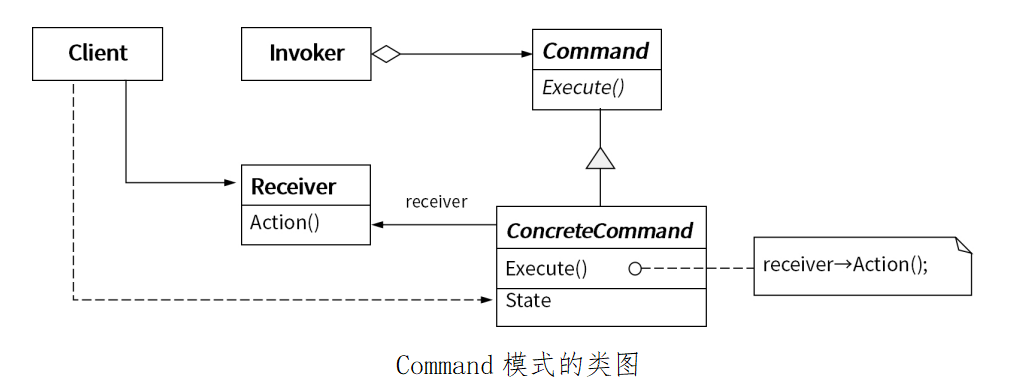 【C++代码】 class Command { public: virtual ~Command() {} // 虚析构函数,确保正确析构派生类对象 (1); // 纯虚函数,子类必须实现 }; // 具体命令实现类 class ConcreteCommand : public Command { private: Receiver* receiver; // 接收者指针 public: ConcreteCommand(Receiver* receiver) : receiver(receiver) {} void execute() override { // 重写execute方法 (2) ; } }; // 接收者类 class Receiver { public: void action() { std::cout << "Executing the command." << std::endl; } }; // 调用者类 class Invoker { private: Command* command; // 命令指针 public: Invoker(Command* command) : command(command) {} void setCommand(Command* command) { this->command = command; } void executeCommand() { if (command != nullptr) { command->execute(); // 执行命令 } } }; // 客户端代码 int main() { // 创建接收者对象 Receiver receiver; // 创建具体命令对象,并将接收者对象传入 (3) ; // 创建调用者对象,并将命令对象传入 (4) ; // 执行命令 (5) ; // 释放动态分配的内存 delete command; return 0; }
参考答案:
(1)virtual void execute() = 0 (2)receiver->action() (3) ConcreteCommand* command = new ConcreteCommand(&receiver) (4) Invoker invoker(command) (5)invoker.executeCommand()
解析(AI 生成):
命令模式把请求封装成对象:Command 声明纯虚函数 execute,(1)为 virtual void execute()=0;具体命令持有接收者,在 execute 中转调 receiver->action();客户端创建具体命令注入 Invoker,由 executeCommand 触发。
问答题
88. 【问题2】 根据实体联系图,将关系模式中的空(a)~(c)补充完整,并分别给出部门、员工和经理关系模式的主键和外键。
材料: 试题二(共15分) 阅读下列说明,回答问题1至问题3,将解答填入的对应栏内。 【说明】 某集团公司拥有多个大型连锁商场,公司需要构建一个数据库系统以方便管理其业务运作活动。 【需求分析结果】 1.商场需要记录的信息包括商场编号(编号唯一),商场名称,地址和联系电话。某商场信息如下表所示。 商场信息表
2.每个商场包含有不同的部门,部门需要记录的信息包括部门编号(集团公司分配),部门名称,位置分布和联系电话。某商场的部门信息如下表所示。 部门信息表
3.每个部门雇用多名员工处理日常事务,每名员工只能隶属于一个部门(新进员工在培训期不隶属于任何部门)。员工需要记录的信息包括员工编号(集团公司分配),姓名,岗位,电话号码和工资。员工信息如下表所示。 员工信息表
4.每个部门的员工中有一名是经理,每个经理只能管理一个部门,系统需要记录每个经理的任职时间。 【概念模型设计】 根据需求阶段收集的信息,设计的实体联系图和关系模式(不完整)如下:
【关系模式设计】 商场(商场编号,商场名称,地址,联系电话) 部门(部门编号,部门名称,位置分布,联系电话, (a) ) 员工(员工编号,员工姓名,岗位,电话号码,工资, (b) ) 经理( (c) ,任职时间)
参考答案:
(a)商场编号 (b)部门编号(c)员工编号 部门关系模式的主键:部门编号;外键:商场编号 员工关系模式的主键:员工编号; 外键:部门编号 经理关系模式的主键:员工编号;外键:员工编号
解析(AI 生成):
补全关系模式要按实体联系图的从属关系填外键:部门隶属于商场,故含商场编号;员工隶属于部门,故含部门编号;经理本身是员工,主键、外键都用员工编号。主键取唯一标识实体的编号属性,外键取上层实体的主键。
[材料型]问答题
89. 试题五(共15分) 阅读下列说明和C++代码,将应填入 (n)处的字句写在答题纸的对应栏内。 【说明】 某实验室欲建立一个实验室环境监测系统,能够显示实验室的温度、湿度以及洁净度等环境数据。当获取到最新的环境测量数据时,显示的环境数据能够更新。 现在采用观察者(Observer)模式来开发该系统。观察者模式的类图如图5-1所示。 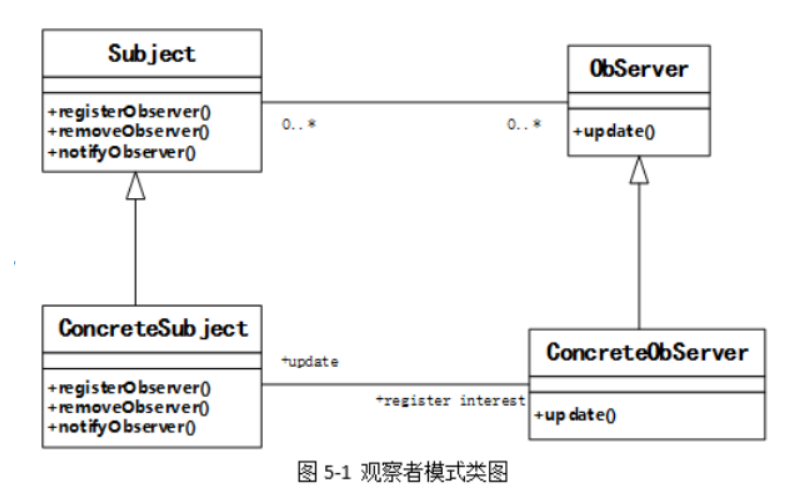 【C++代码】 include <iostream> include <vector> using namespace std; class Observer { public: virtual void update(float temp, float humidity, float cleanness)=0; }; class Subject { public: virtual void registerObserver(Observer* o) = 0; //注册对主题感兴趣的观察者 virtual void removeObserver(Observer* o) = 0; //删除观察者 virtual void notifyObservers() = 0;//当主题发生变化时通知观察者 }; class EnvironmentData : public (1) { private: vector<Observer*> observers; float temperature, humidity, cleanness; public: void registerObserver(Observer* o) { observers.push_back(o); } void removeObserver(Observer* o) { /* 代码省略 / } void notifyObservers() { for(vector<Observer>::const_iterator it = observers.begin(); it != observers.end(); it++) { (2) ; } } Void measurementsChanged() { (3) ; } void setMeasurements(float temperature, float humidity, float cleanness) { this->temperature = temperature; this->humidity = humidity; this->cleanness = cleanness; (4) ; } }; class CurrentConditionsDisplay : public Observer { private: float temperature, humidity, cleanness; Subject* envData; public: CurrentConditionsDisplay(Subject* envData) { this->envData = envData; (5) ; } void update(float temperature, float humidity, float cleanness) { this->temperature = temperature; this->humidity = humidity; this->cleanness = cleanness; display(); } void display() { /* 代码省略 / } }; int main() { EnvironmentData envData = new EnvironmentData(); CurrentConditionsDisplay* currentDisplay = new CurrentConditionsDisplay(envData); envData->setMeasurements(80, 65, 30.4f); return 0; }
材料: 试题五(共15分) 阅读下列说明和C++代码,将应填入 (n)处的字句写在答题纸的对应栏内。 【说明】 某实验室欲建立一个实验室环境监测系统,能够显示实验室的温度、湿度以及洁净度等环境数据。当获取到最新的环境测量数据时,显示的环境数据能够更新。 现在采用观察者(Observer)模式来开发该系统。观察者模式的类图如图5-1所示。
参考答案:
(1)Subject (2)(*it)->update(remperature,humidity,cleanness) (3)notifyObservesers() (4) mesasurementsChanged() (5) envData->regisiterObserver(this)
解析:
本题考察观察者(Observer)模式的概念及应用。
观察者模式定义对象间的一种一对多的依赖关系,当一个对象的状态发生改变时,所有依赖于它的对象都得到通知并被自动更新。
Observer模式适用于:
①当一个抽象模型有两个方面,其中一个方面依赖于另一个方面。将这两者封装在独立地对象中以使它们可以各自独立地改变和复用。
②当对一个对象的改变需要同时改变其他对象,而不知道具体有多少对象有待改变时。
③当一个对象必须通知其他对象,而它又不能假定其他对象是谁,即:不希望这些对象是紧耦合的。
观察者模式的结构如下图所示,其中:
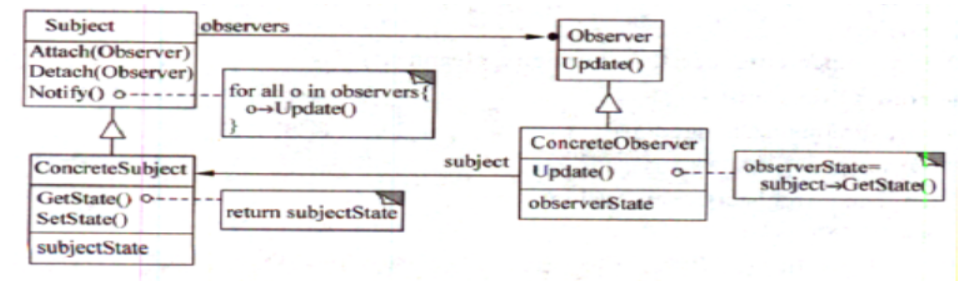 Subject (主题)知道它的观察者,可以有任意多个观察者观察同一个目标;提供注册和删除观察者对象的接口。
Observer (观察者)为那些在目标发生改变时需获得通知的对象定义一个更新接口。
ConcreteSubject (具体主题)将有关状态存入一个ConcreteObserver对象;当它的状态发生改变时,向它的各个观察者发出通知。
ConcreteObserver (具体观察者)维护一个指向ConcreteSubject对象的引用;存储有关状态,这些状态应与主题的状态保持一致;实现Observer的更新接口以使自身状态与主题的状态保持一致。
在本题的说明中,给出了观察者模式的结构图,答题时需要首先确定程序中的类与观察者模式结构的对应关系,也就是要找到哪些是ConcreteSubject,哪些是 ConcreteObserver。由程序上下文可以判断出,类EnvironmentData对应的是ConcreteSubject,类CurrentConditionsDisplay 对应的是ConcreteObserver。根据类图,它们分别为Subject和Observer的子类。由此可以,空(1) Subject。
空(2)要求给出方法notifyObservers的实现,其功能是在主题发生变化时通知观察者。通知的实现是通过向对该主题感兴趣的所有观察者发送update消息实现的。对主题EnvironmentData感兴趣的观察者由向量observers表示,所以在notifyObservers方法中,就是对向量observers中的每个成员发送update消息,因此空(2)应填写 (*it)->update(temperature, humidity, cleanness)。
方法measurementsChanged表示主题发生了变化,这时应该通知对应的观察者,所以空(3)处应填写notifyObservers()。
方法setMeasurements用于设置发生变化后的主题内容,所以空(4)处应填写measurementsChanged()。
CurrentConditionsDisplay是对主题EnvironmentData感兴趣的一个观察者,要能够获得主题的变化,需要首先将自己注册为该主题的观察者,这个注册行为在其构造函数中完成。因此空(5)处应填写envData->registerObserver(this)。
问答题